
Checking if your email was in a breach and assessing real exposure risks
Credential reuse across unrelated platforms turns a minor external data leak into an immediate internal network compromise for small teams.
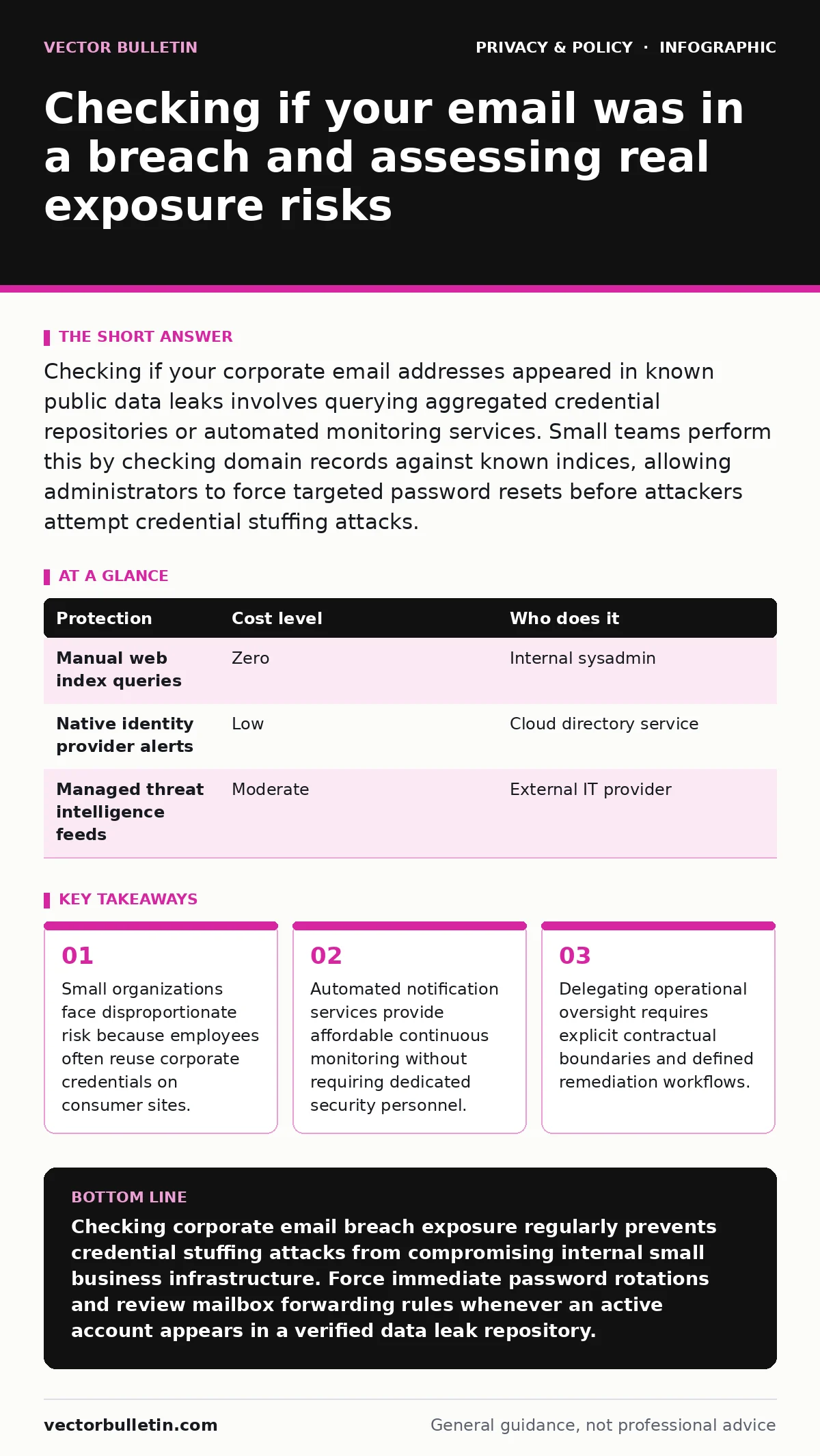
Checking if your corporate email addresses appeared in known public data leaks involves querying aggregated credential repositories or automated monitoring services. Small teams perform this by checking domain records against known indices, allowing administrators to force targeted password resets before attackers attempt credential stuffing attacks.
Why Small Teams Face Unique Credential Risks
Small organisations often lack perimeter defenses robust enough to withstand targeted campaigns, making employee email accounts primary entry points for attackers. Limited technical staff means individual users choose their own access credentials for third-party web services. Attackers harvest these credentials from unrelated consumer platforms and test them directly against corporate authentication portals using automated scripts. 3 compromised employee mailboxes can expose an entire firm's internal communications, financial records, and sensitive client agreements without triggering traditional perimeter alarms.
Credential stuffing exploits human habits rather than technical flaws in your primary infrastructure. Employees frequently utilize identical secret phrases across multiple digital environments, assuming minor web applications maintain enterprise-grade security standards. Tracing historical exposure helps security teams identify which individuals maintain risky habits, but manual audits consume valuable operational hours. Automated domain monitoring transforms reactive firefighting into a predictable hygiene task, though it requires clear internal policies to handle discovered exposures effectively.
How Public Leak Indices Actually Operate
Public leak indices compile billions of historical records gathered from underground forums, public paste sites, and discovered server misconfigurations. Security researchers parse these massive text repositories to extract email addresses, usernames, and hashed or plaintext secrets. 2 distinct methods govern how these databases surface information to defenders: bulk raw downloads for offline analysis and queried application programming interfaces that return binary match results. Understanding this distinction prevents administrators from accidentally exposing internal architecture while searching for compromised assets.
Raw data archives demand significant local storage and specialized parsing utilities to extract actionable intelligence from unstructured text dumps. Cloud-based query tools offer simpler interfaces but introduce privacy trade-offs when transmitting corporate domain lists to external third-party infrastructure. Analysts must weigh the risk of data leakage against the operational convenience of automated lookup services. False positives frequently occur when legacy aliases or defunct service accounts match current active staff members, requiring manual verification before initiating password resets.
Affordable Methods for Monitoring Corporate Domains
Affordable monitoring relies on leveraging free public lookup tools and native directory service notifications to catch compromised credentials early. Small businesses configure domain-level alerts through identity providers that automatically flag matching records found in known repository feeds. 3 primary tiers of tools exist for this purpose, ranging from zero-cost web queries to subscription-based continuous feed integrations. Administrators paste their root domain suffix into lookup interfaces to receive notifications whenever a newly discovered database references an address matching their corporate namespace.
| Protection | Cost level | Who does it |
|---|---|---|
| Manual web index queries | Zero | Internal sysadmin |
| Native identity provider alerts | Low | Cloud directory service |
| Managed threat intelligence feeds | Moderate | External IT provider |
Manual checks require disciplined scheduling, often failing during busy operational periods when staff abandon routine security chores. Automated directory integrations shift the burden from human memory to background software processes, ensuring alerts arrive immediately upon database publication. Budget constraints dictate which tier an organisation selects, but even basic domain-level tracking drastically reduces the window of vulnerability between a leak occurring and a password rotation taking place.
What Responsibilities to Delegate to External Providers
Outsourcing email monitoring to an external information technology provider requires precise contractual definitions to ensure accountability during a crisis. Managed service providers typically handle the technical configuration of domain alerts and initial triage of exposed credentials. 4 specific boundaries must be established in the service agreement: who authorises emergency password resets, who contacts affected staff members, how fast alerts are investigated, and what reporting formats are delivered monthly. Delegating the technical lookup prevents internal staff from missing notifications, but the organisation must retain authority over policy enforcement.
External vendors occasionally apply generic remediation steps that disrupt normal business workflows without addressing the root cause of the credential exposure. Clear escalation paths prevent technicians from locking out senior executives without prior confirmation during critical operational hours. Regular service reviews ensure the provider actively monitors current threat intelligence feeds rather than relying on outdated static watchlists. Security teams must audit the provider's access logs periodically to verify that external personnel do not abuse their elevated privileges within the corporate directory.
Hidden Costs of Manual Leak Verification
Manual verification of leaked accounts introduces hidden operational overhead that frequently exceeds the cost of automated subscription tools. Security administrators spend countless hours cross-referencing raw data dumps against active directory user lists to eliminate false positives and outdated aliases. 5 distinct hidden costs drain resources during manual audits: lost productivity from unnecessary organisation-wide password resets, employee anxiety regarding personal privacy, diverted focus from strategic projects, delayed incident response times, and incomplete coverage of shadow information technology assets.
Relying entirely on manual searches leaves blind spots where employees utilize unapproved software applications using corporate communication channels. These unsanctioned tools bypass perimeter visibility, meaning a credential leak originating from a rogue application remains entirely invisible to standard administrative oversight. Automated monitoring mitigates some of these blind spots by scanning broader public repositories beyond simple corporate domain matches. However, managing the resulting notification volume demands disciplined prioritisation to prevent alert fatigue among small security teams.
See also: Vulnerability Disclosure Policies for Small Teams
Managing Secondary Exposure from Personal Data
Secondary exposure occurs when corporate email addresses appear alongside sensitive personal data within leaked consumer databases. Employees often register for unrelated commercial services using their professional contact details, creating distinct vectors for targeted social engineering attacks. Spear-phishing campaigns leverage this leaked contextual information to craft convincing messages that bypass standard email filtering rules. Mitigation requires educating staff about the risks of mixing professional identities with private consumer accounts across the public web.
Handling discovered exposures often intersects with broader regulatory frameworks governing personal data protection within your jurisdiction. When an employee database leaks containing corporate credentials alongside private telephone numbers, administrators must navigate statutory notification requirements. Managing data subject access requests becomes significantly more complex when external actors publish internal contact directories alongside confidential operational files. Comprehensive data governance policies help small businesses categorize information correctly, ensuring that leaked metadata receives appropriate remediation attention.
Establishing Internal Remediation Workflows
Internal remediation workflows transform raw leak notifications into structured defensive actions before attackers leverage compromised credentials. Quick containment demands a pre-defined sequence of operational steps executed immediately upon confirming a valid account match. 3 mandatory actions comprise a standard remediation cycle: immediate session termination across all active cloud services, forced password updates using distinct cryptographic secrets, and a review of recent mailbox audit logs for unauthorized rule creation. Establishing these procedures in advance prevents panicked improvisation during active security incidents.
Attackers frequently establish persistence within compromised email environments by creating hidden forwarding rules or delegating mailbox access permissions to external accounts. Standard password resets alone fail to remove these persistent mechanisms, leaving the adversary with continued visibility into internal communications. Security teams must inspect mailbox configuration settings manually or via automated scripting after forcing credential updates. Documenting every remediation step ensures continuous improvement of your incident response posture over time.
Key takeaways
- Small organizations face disproportionate risk because employees often reuse corporate credentials on consumer sites.
- Automated notification services provide affordable continuous monitoring without requiring dedicated security personnel.
- Delegating operational oversight requires explicit contractual boundaries and defined remediation workflows.
Checking corporate email breach exposure regularly prevents credential stuffing attacks from compromising internal small business infrastructure. Force immediate password rotations and review mailbox forwarding rules whenever an active account appears in a verified data leak repository.
Frequently asked questions
How often should a small business check corporate email addresses for breach exposure?
Continuous automated monitoring provides the highest level of assurance, but monthly manual checks suffice for teams with strict credential policies.
Do password managers prevent email addresses from appearing in public data leaks?
Password managers generate unique secrets for every service, preventing a breach on one website from compromising your corporate login credentials.
What should you do if an executive refuses to reset a leaked password?
Enforce temporary account suspension through your directory provider until the user complies with mandatory security hygiene protocols.
Does checking an email address on public lookup sites expose your network?
Querying reputable lookup services with a corporate domain name carries negligible risk, provided you avoid inputting plaintext passwords into untrusted web forms.
How this guide was produced: written by the Vector Bulletin editorial team with AI assistance, checked against the public references listed below, and reviewed when the facts change. See our editorial policy or report an error.