
Speculative Execution Vulnerabilities Explained for Beginners
Processors execute instructions ahead of time to gain speed, leaving temporary data traces that attackers can measure to reconstruct sensitive information.
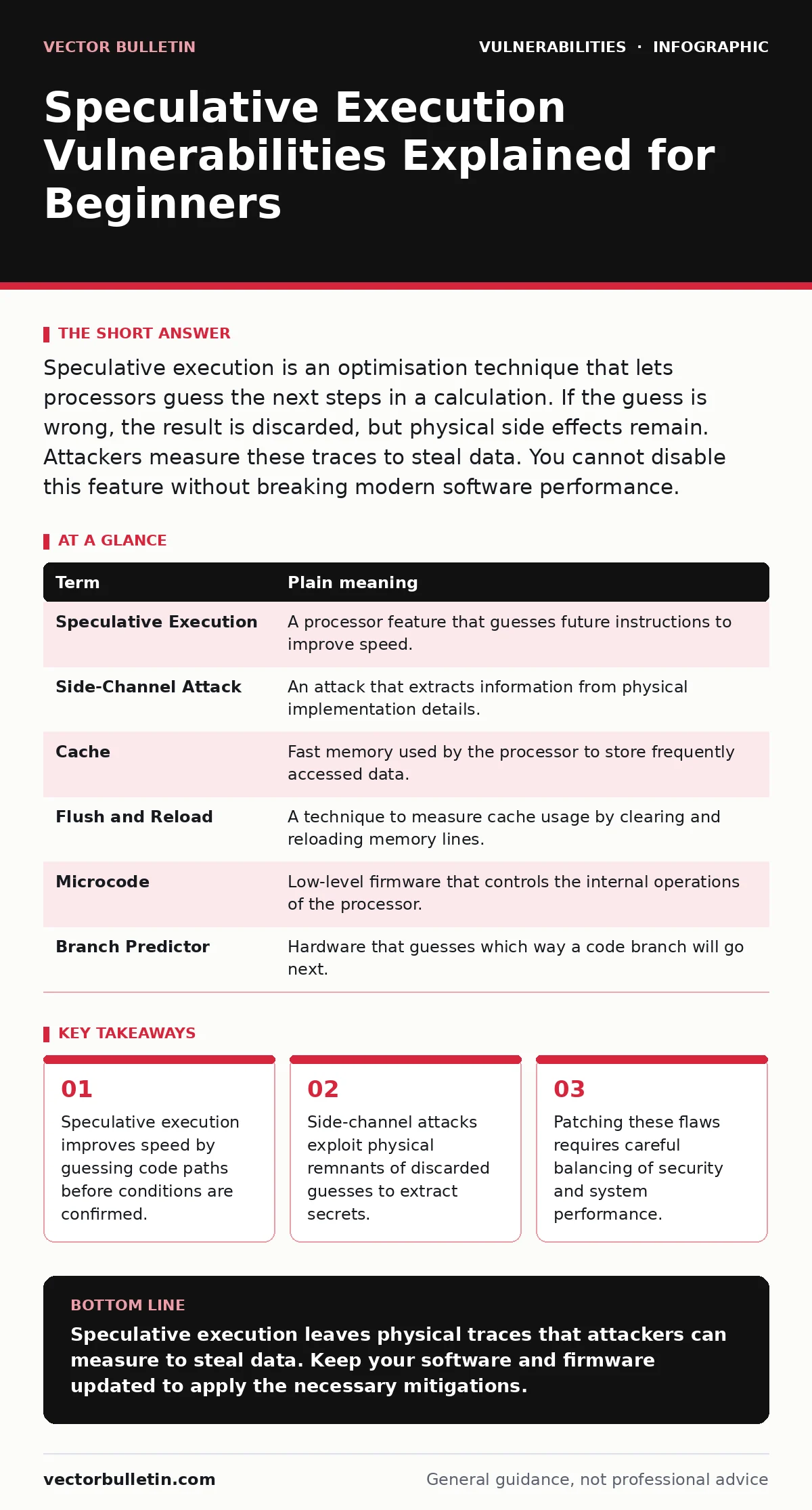
Speculative execution is an optimisation technique that lets processors guess the next steps in a calculation. If the guess is wrong, the result is discarded, but physical side effects remain. Attackers measure these traces to steal data. You cannot disable this feature without breaking modern software performance.
How Processors Guess Your Next Move
Modern processors use speculative execution to maintain high throughput. Imagine a railway signalman who sees a train approaching a junction. The signalman does not wait for the driver to confirm the direction. Instead, the signalman prepares both tracks simultaneously. If the train takes the left track, the right preparation is discarded. This guesswork allows the processor to keep its internal pipelines full. The mechanism prevents idle cycles when the processor waits for data from memory.
The processor commits only the results of the correct path. It discards the results of the wrong path. However, the physical act of preparing the wrong path leaves traces. These traces include changes in cache memory states or power consumption levels. An attacker can measure these physical side effects. The attacker then reconstructs the data that was processed during the discarded guess.
The Mechanics of Side-Channel Extraction
The vulnerability arises because the discarded state is not fully erased from physical components. The processor assumes that software cannot observe these transient states. Software operates at a logical level. Physical hardware operates at an electrical level. The gap between logic and physics creates the attack surface.
Attackers use timing attacks to probe this gap. They run a small piece of code that triggers speculative execution. They then measure how long it takes to access specific memory locations. If a secret key influenced the speculative path, the cache will be warmed for certain values. The attacker reads the cache state to infer the secret. This method works across different privilege levels. It can even cross virtual machine boundaries in some configurations.
Key Terms for Understanding the Flaw
| Term | Plain meaning |
|---|---|
| Speculative Execution | A processor feature that guesses future instructions to improve speed. |
| Side-Channel Attack | An attack that extracts information from physical implementation details. |
| Cache | Fast memory used by the processor to store frequently accessed data. |
| Flush and Reload | A technique to measure cache usage by clearing and reloading memory lines. |
| Microcode | Low-level firmware that controls the internal operations of the processor. |
| Branch Predictor | Hardware that guesses which way a code branch will go next. |
Impact on Ordinary Users
You cannot disable speculative execution on modern devices. Doing so would reduce processor speed by significant margins. Most operating systems and applications rely on this performance boost. Disabling it would make everyday tasks like web browsing or video playback sluggish. Therefore, the risk is managed rather than eliminated.
The primary concern for you is software that handles sensitive data. Web browsers, virtual machines, and cloud platforms are the main targets. If a malicious website runs in your browser, it might attempt to steal data from other tabs. This includes session cookies or encryption keys. The attack requires sophisticated code, but it is possible. Your personal data is at risk if you visit untrusted sites.
Suppose you use a virtual machine to isolate a suspicious program. The program might still read data from the host system. This happens because the CPU cache is shared between the guest and the host. The isolation provided by software is not absolute when hardware is involved. This is similar to sandbox escape vulnerabilities where a contained process breaks out of its restricted environment.
Safety Habits and Mitigation
You cannot fix this vulnerability yourself. The mitigation requires patches from operating system vendors and hardware manufacturers. These patches add checks to ensure that speculative execution does not leak data. Some patches change how the processor handles branch predictions. Others add barriers to prevent data flow across privilege boundaries.
Keep your operating system and applications updated. Updates often include microcode updates for the processor. These updates fix the hardware logic to prevent the leak. Check for updates regularly. Do not ignore security patches even if they seem minor. They often address these deep-level issues.
Consider your software supply chain. Vulnerabilities in widely used libraries can expose you to risk. For example, Java deserialization vulnerabilities can allow remote code execution. If an attacker executes code on your system, they can launch speculative execution attacks. Keeping your IT asset inventory up to date helps you track which systems need patching.
Try This Now: 3 Steps
- Update your operating system. Ensure your device receives the latest security patches. These patches often include microcode updates that mitigate speculative execution flaws.
- Update your browser. Web browsers are the primary target for these attacks. Keep your browser current to benefit from software-level mitigations.
- Audit your plugins. Remove unnecessary browser extensions. Fewer plugins mean a smaller attack surface. A malicious extension could facilitate a side-channel attack.
Related Vulnerability Context
Understanding speculative execution helps you appreciate other hardware and software flaws. For instance, insecure direct object references (IDOR) allow users to access data they should not see. While IDOR is a logical error, speculative execution is a physical one. Both result in unauthorized data access.
You might also encounter JWT vulnerabilities in web applications. JSON Web Tokens are used for authentication. If these tokens are leaked via side-channel attacks, an attacker can impersonate you. This highlights the need for layered security. No single control stops all attacks.
The Trade-Off of Security
Security often comes with a performance cost. Mitigating speculative execution vulnerabilities can slow down your computer. The processor must wait for certain operations to complete before proceeding. This reduces the efficiency of the pipeline. You must accept this trade-off. The alternative is leaving the system open to sophisticated attacks.
Organisations must balance these factors. They may choose to disable certain mitigations for high-performance servers. This decision requires a thorough risk assessment. For individual users, the default settings are usually sufficient. The convenience of speed is not worth the risk of data theft.
Refer to the National Vulnerability Database for specific details on known flaws. This database provides structured information about vulnerabilities. It helps you understand the scope of the issue. Understanding the vulnerability disclosure policies of vendors can also help you anticipate when patches will be released.
Key takeaways
- Speculative execution improves speed by guessing code paths before conditions are confirmed.
- Side-channel attacks exploit physical remnants of discarded guesses to extract secrets.
- Patching these flaws requires careful balancing of security and system performance.
Speculative execution leaves physical traces that attackers can measure to steal data. Keep your software and firmware updated to apply the necessary mitigations.
Frequently asked questions
Can I disable speculative execution to be safe?
No, disabling it significantly reduces performance and may break compatibility with modern operating systems and applications.
Does antivirus software protect me from these attacks?
Antivirus software detects known malware. It cannot prevent the physical side effects of speculative execution or measure cache timing attacks.
Are older processors more vulnerable?
Older processors may have fewer mitigations built into their microcode, but newer processors also have complex speculative features that can be exploited.
How do I know if my device is patched?
Check your operating system update logs for security patches. Vendor websites often list which microcode versions address specific speculative execution flaws.
How this guide was produced: written by the Vector Bulletin editorial team with AI assistance, checked against the public references listed below, and reviewed when the facts change. See our editorial policy or report an error.