Java Deserialization Vulnerabilities: Causes, Fixes and Gadget Chains
Java deserialization flaws bypass code execution controls by abusing trusted object reconstruction logic, rendering standard input validation ineffective against crafted data streams.
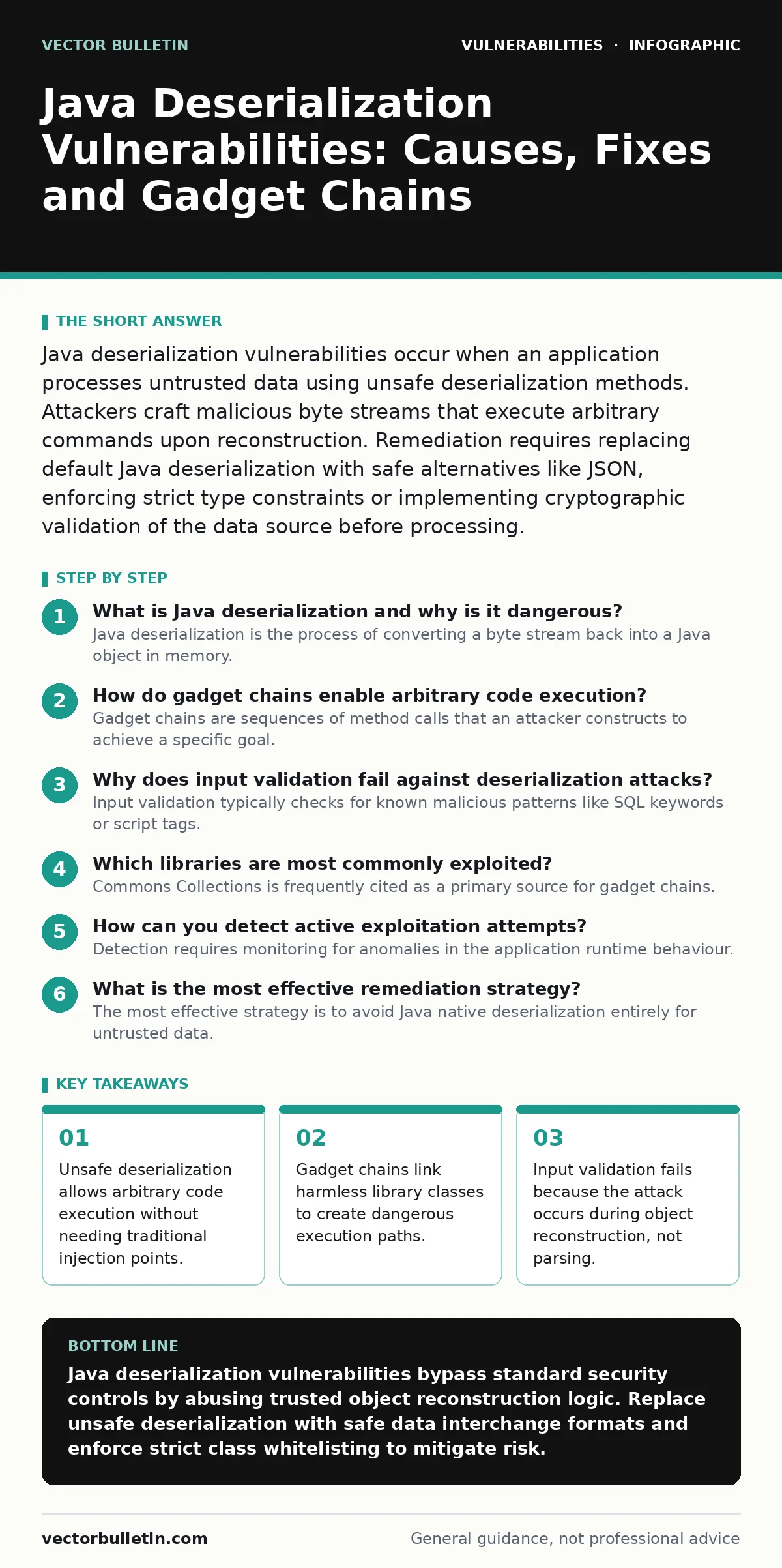
Java deserialization vulnerabilities occur when an application processes untrusted data using unsafe deserialization methods. Attackers craft malicious byte streams that execute arbitrary commands upon reconstruction. Remediation requires replacing default Java deserialization with safe alternatives like JSON, enforcing strict type constraints or implementing cryptographic validation of the data source before processing.
What is Java deserialization and why is it dangerous?
Java deserialization is the process of converting a byte stream back into a Java object in memory. The danger arises because the Java Virtual Machine trusts the stream to represent a valid object graph. When an application deserialises untrusted data, it reconstructs the object state exactly as defined in the stream. This reconstruction can trigger static initialisers or method calls automatically.
The application executes this code with the same privileges as the application itself. This mechanism bypasses security controls that monitor network traffic or file systems. The trust assumption embedded in the Java runtime makes the attack surface invisible to standard perimeter defences. Attackers exploit this by sending a crafted stream that forces the JVM to execute malicious instructions during the reconstruction phase.
How do gadget chains enable arbitrary code execution?
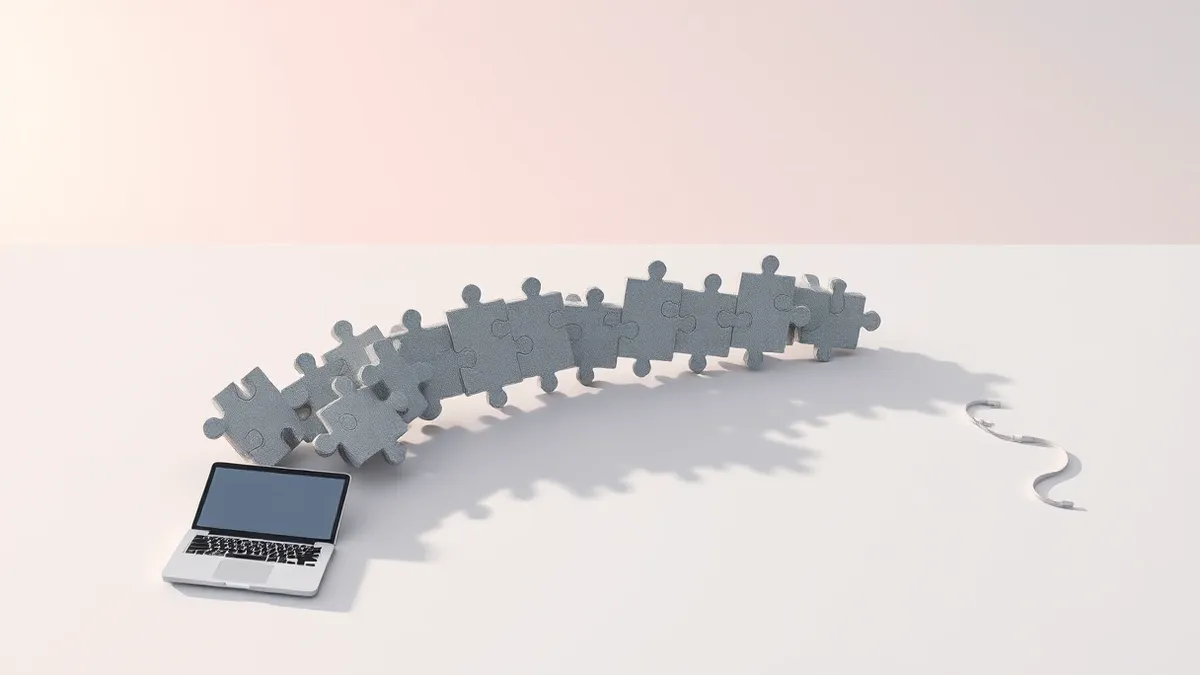
Gadget chains are sequences of method calls that an attacker constructs to achieve a specific goal. A single class rarely provides a direct path to command execution. Attackers combine multiple classes from standard libraries or third-party dependencies to form a chain. Each class acts as a gadget that passes control to the next. The chain starts with a deserialisable object and ends with a dangerous operation like file writing or command execution.
The existence of these chains depends on the library versions present in the application classpath. Even if the application code itself is secure, the presence of vulnerable libraries creates the attack vector. Security teams must map the entire dependency tree to identify potential gadget sources. This complexity makes static analysis difficult and often requires dynamic testing to confirm exploitability.
Why does input validation fail against deserialization attacks?
Input validation typically checks for known malicious patterns like SQL keywords or script tags. Deserialization attacks do not contain readable scripts or commands in the byte stream. The stream appears as random binary data to a naive validator. The malicious intent is encoded in the structure of the object graph, not in the raw bytes. By the time the application parses the stream, the JVM has already begun executing the reconstruction logic.
Validation tools that inspect content length or character sets miss the structural anomalies that define the attack. The attack happens at the object reconstruction layer, which sits below the application logic layer. This architectural separation renders traditional web application firewalls largely ineffective against sophisticated deserialization payloads.
Which libraries are most commonly exploited?
Commons Collections is frequently cited as a primary source for gadget chains. This library provides utility classes that often have methods triggering code execution when specific properties are accessed. Spring Framework components also offer potential execution paths through their configuration handling mechanisms. Log4j provides logging utilities that can be abused if an attacker controls the message format string.
Jackson and Gson are data binding libraries that can execute dangerous methods during property setting. The risk depends on which classes are reachable from the deserialised object. Applications using older versions of these libraries face higher risk due to known, well-documented gadget chains. Regular dependency scanning helps identify if these libraries are present in the classpath. Even transitive dependencies can introduce these risks without direct reference in the code.
How can you detect active exploitation attempts?
Detection requires monitoring for anomalies in the application runtime behaviour. Sudden spikes in CPU usage or memory allocation often indicate complex object graph reconstruction. Unusual process spawns or file access patterns signal successful execution of gadget chains. Network connections to unexpected destinations may result from reverse shell commands embedded in the payload.
Monitoring tools should inspect for the presence of known gadget class names in memory dumps. Log analysis can reveal errors related to class loading or unexpected method invocations. However, many attacks execute quickly and leave minimal traces. The absence of error logs does not guarantee safety. Continuous monitoring of process creation and network activity provides the best chance of identifying an ongoing attack.
What is the most effective remediation strategy?
The most effective strategy is to avoid Java native deserialization entirely for untrusted data. Replace byte-stream deserialisation with data interchange formats like JSON or XML. These formats require explicit parsing logic that does not automatically execute code during reconstruction. If native deserialization is unavoidable, implement a custom ObjectInputStream to restrict which classes can be loaded.
Maintain a whitelist of allowed classes and reject any attempt to instantiate others. This approach shifts the security model from blacklisting to whitelisting. Cryptographic signing of the data stream ensures integrity and authenticity before processing. The signer must be trusted and the verification must occur before any object reconstruction. This multi-layered approach significantly reduces the attack surface.
| Remediation Method | Effectiveness | Implementation Complexity | Maintenance Overhead |
|---|---|---|---|
| Switch to JSON/XML | High | Medium | Low |
| Class Whitelisting | High | High | High |
| Input Sanitisation | Low | Low | Low |
| Cryptographic Signing | High | Medium | Medium |
Can Web Application Firewalls stop these attacks?
Web application firewalls struggle with deserialization attacks because they operate at the application layer. They inspect HTTP headers and body content for known malicious signatures. The binary nature of Java serialized data obscures the malicious intent from signature-based detection. While some advanced firewalls can detect known gadget class signatures, they miss novel chains.
The firewall sees a valid HTTP POST request with binary data. It cannot easily distinguish between legitimate object transfer and malicious code execution. Relying solely on a web application firewall creates a false sense of security. Defence in depth is required, with application-level controls handling the primary protection. The firewall should serve as a supplementary layer, not the primary defence.
How do you assess the severity of a deserialization flaw?
Assessing severity requires understanding the context of the vulnerable component. A deserialization flaw in an internal service with no external access poses lower risk. A flaw in a public-facing API with authentication bypass capabilities poses critical risk. The availability of public exploit code for the specific library version increases the likelihood of attack.
Security teams should consult vulnerability severity ratings to understand the potential impact. These ratings help prioritise remediation efforts based on risk. The presence of a known gadget chain in the application classpath confirms exploitability. Without a viable chain, the vulnerability may remain theoretical. Testing the specific environment is necessary to determine true risk.
What role does dependency management play in prevention?
Dependency management ensures that applications only use vetted and secure libraries. Regularly updating dependencies removes known vulnerable classes from the classpath. Tools that scan for known vulnerable libraries help maintain a clean dependency tree. However, updating libraries alone does not fix the underlying architectural flaw. The application must still handle data safely.
Dependency management reduces the pool of available gadgets for attackers. It is a defensive measure that raises the barrier to entry for exploitation. Combined with safe data handling practices, it significantly reduces risk. Teams must establish a process for reviewing new dependencies before integration. This proactive approach prevents the introduction of fresh attack vectors.
Key takeaways
- Unsafe deserialization allows arbitrary code execution without needing traditional injection points.
- Gadget chains link harmless library classes to create dangerous execution paths.
- Input validation fails because the attack occurs during object reconstruction, not parsing.
Java deserialization vulnerabilities bypass standard security controls by abusing trusted object reconstruction logic. Replace unsafe deserialization with safe data interchange formats and enforce strict class whitelisting to mitigate risk.
Frequently asked questions
Does using HTTPS prevent Java deserialization attacks?
No, HTTPS encrypts the data in transit but does not validate the content. The application still processes the malicious stream upon receipt.
Can I fix this by validating the JSON structure?
If you switch to JSON, validation helps, but the core issue is the deserialization mechanism. Ensure the parser does not execute code during parsing.
Is whitelisting classes enough for protection?
Whitelisting is effective but requires maintenance. New classes added to the application must be reviewed and added to the whitelist manually.
How do I know if my application is vulnerable?
Search your codebase for ObjectInputStream.readObject() calls. If these process untrusted data without validation, your application is likely vulnerable.
How this guide was produced: written by the Vector Bulletin editorial team with AI assistance, checked against the public references listed below, and reviewed when the facts change. See our editorial policy or report an error.