
Sandbox Escape Mechanisms: How Boundaries Fail and What Breaks
Sandbox escapes rely on the assumption that untrusted code cannot influence the host kernel, a premise that breaks when memory management flaws allow boundary traversal.
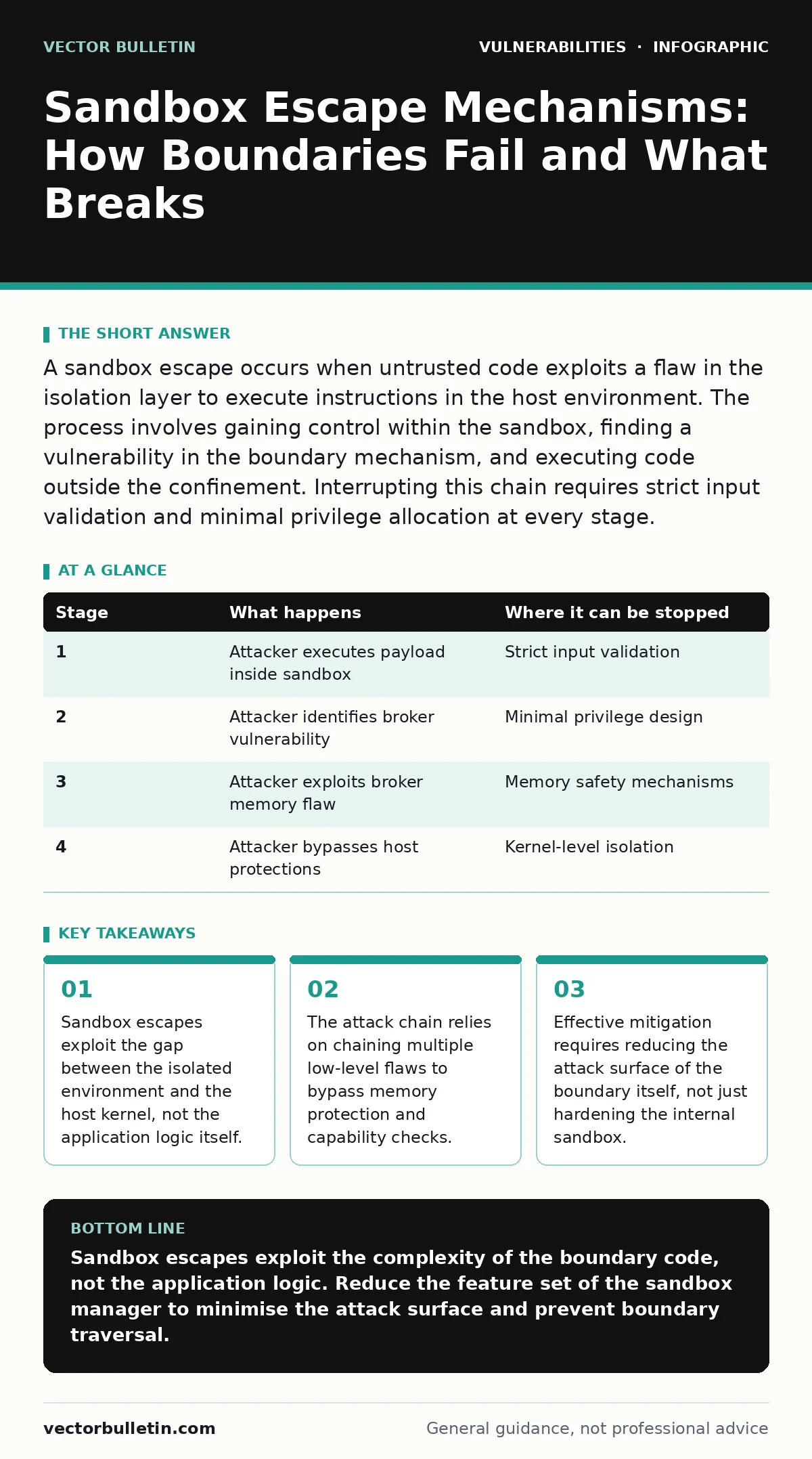
A sandbox escape occurs when untrusted code exploits a flaw in the isolation layer to execute instructions in the host environment. The process involves gaining control within the sandbox, finding a vulnerability in the boundary mechanism, and executing code outside the confinement. Interrupting this chain requires strict input validation and minimal privilege allocation at every stage.
The Anatomy of Confinement Failure
Sandboxing isolates untrusted code by restricting its access to system resources. This isolation relies on a boundary that separates the guest environment from the host. When this boundary fails, the untrusted code gains access to the host's memory, files, or network stack. The failure is rarely a single mistake. It is usually a sequence of small deviations from expected behaviour. The attacker must first operate within the strict limits of the sandbox. They then identify a mechanism that bridges the gap to the host. Finally, they exploit that bridge to execute code with higher privileges.
Imagine a browser rendering a malicious webpage. The browser runs the page in a sandboxed process. If that process can write to the browser's main memory, the sandbox has failed. This is not a breach of the webpage's logic. It is a breach of the container holding the webpage. Understanding the stages of this breach reveals where defences can be inserted.
The Entry Point and Initial Foothold
The attacker begins inside the sandbox. They have no direct access to the host system. Their goal is to find a way to influence the code that manages the sandbox. This code is often called the broker or the monitor. The attacker looks for inputs that the broker processes. These inputs might be system calls, file operations, or network requests. The attacker crafts an input that behaves unexpectedly. This unexpected behaviour must trigger a flaw in the broker's handling logic.
The flaw is often a memory corruption issue. The broker may misinterpret the size of a data buffer. It might copy more data than the buffer can hold. This overflow allows the attacker to overwrite adjacent memory. That memory might contain return addresses or function pointers. By controlling these values, the attacker can redirect the flow of execution. The attacker is still inside the sandbox, but they now control the sandbox manager.
Stage 1: Gaining Control Within the Sandbox
The first stage involves establishing a foothold. The attacker executes code within the restricted environment. This code must be resilient against the sandbox's internal protections. It must avoid detection by any internal monitoring. The attacker uses the sandbox's allowed features to perform reconnaissance. They map the memory layout of the process. They identify the location of the broker's code. They look for predictable memory addresses.
| Stage | What happens | Where it can be stopped |
|---|---|---|
| 1 | Attacker executes payload inside sandbox | Strict input validation |
| 2 | Attacker identifies broker vulnerability | Minimal privilege design |
| 3 | Attacker exploits broker memory flaw | Memory safety mechanisms |
| 4 | Attacker bypasses host protections | Kernel-level isolation |
Exploiting the Boundary Mechanism
The sandbox manager handles requests from the sandboxed process. It validates these requests against a policy. If the policy allows the request, the manager performs it on behalf of the sandbox. The vulnerability lies in this validation or execution step. The attacker sends a crafted request that the manager misinterprets. The manager might think it is reading a safe file. In reality, it is reading a file chosen by the attacker. Or the manager might think it is executing a safe command. It is executing a command that opens a shell.
This stage relies on the complexity of the boundary. The more features the sandbox supports, the more code the manager must contain. More code means more potential flaws. The attacker looks for logic errors. These errors occur when the manager fails to consider all possible states. For instance, the manager might not check if a file has been deleted between the time it was validated and the time it was accessed. This race condition allows the attacker to substitute a malicious file.
Stage 2: Triggering the Boundary Flaw
The attacker triggers the flaw in the boundary mechanism. This requires precise timing and specific conditions. The attacker must ensure that the system is in a state that the manager did not anticipate. They might use multiple threads to create a race condition. They might use large data structures to exhaust memory. The goal is to force the manager into an error state. In this state, the manager's checks are bypassed or ignored.
The attacker exploits this state to perform an action that should be forbidden. They might write to a memory region that belongs to the host. They might execute a system call that changes user privileges. The sandbox is now compromised. The attacker has moved from a restricted context to a less restricted one. They have not yet escaped, but they have broken the primary barrier.
Bypassing Host Protections
The host system has its own protections. These include address space layout randomisation, data execution prevention, and control flow integrity. The attacker must bypass these to maintain control. They use techniques like return-oriented programming. This technique chains small snippets of existing code to perform complex operations. It avoids executing new code, which might be blocked. The attacker builds a chain of instructions that disables protections. They then prepare the environment for the final escape.
This stage is often the most difficult. The host protections are designed to stop exactly this kind of attack. The attacker must find a way to predict memory addresses. They might use information leaks to reveal the location of critical data. They might use brute force to guess the correct addresses. The success of this stage depends on the robustness of the host's security features. If the host uses strong randomisation, the attacker must find a way to defeat it.
Stage 3: Escaping to the Host
The final stage is the escape itself. The attacker executes code in the host environment. This code runs with the privileges of the sandbox manager. If the manager runs with high privileges, the attacker now has high privileges. They can install malware, steal data, or pivot to other systems. The sandbox is no longer a barrier. It is a bridge. The attacker has crossed it. The host system is now compromised. The initial untrusted code has become a trusted component of the host.
The escape is complete when the attacker can interact with the host's resources directly. They can read files from the host's disk. They can open network connections from the host's network interface. They can interact with other processes on the host. The isolation is gone. The attacker has achieved their goal. The damage is now limited only by the attacker's intent and the host's remaining defences.
Interrupting the Attack Chain
Each stage of the escape can be interrupted. The key is to reduce the attack surface at every step. Input validation prevents the initial foothold. Minimal privilege design limits the impact of a boundary flaw. Memory safety mechanisms prevent exploitation of memory errors. Kernel-level isolation prevents the final escape. These measures must be applied together. No single measure is sufficient. The attacker will find a way around any single defence. A layered approach is necessary.
The most effective defence is simplicity. The fewer features the sandbox supports, the less code the manager contains. The less code there is, the fewer flaws exist. This principle applies to all software. It is especially critical for sandboxing. The boundary must be simple enough to verify. It must be robust enough to withstand attack. This requires careful design and rigorous testing.
The Hidden Cost of Complexity
Sandboxing adds complexity to the system. This complexity has a cost. It increases the time required to develop and maintain the software. It increases the risk of introducing new vulnerabilities. It makes it harder to diagnose and fix issues. This cost is often overlooked. Organisations focus on the security benefit. They ignore the operational burden. The result is a sandbox that is difficult to manage and prone to failure.
The hidden cost is also in the false sense of security. Organisations assume the sandbox provides complete protection. They do not invest in other defences. They rely on the sandbox to stop all attacks. When the sandbox fails, they are unprepared. The attack succeeds because the organisation did not have a backup plan. The sandbox is not a silver bullet. It is one layer of defence. It must be supported by other measures.
Beyond the Sandbox
Sandboxing is not the only defence. Other mechanisms can complement it. For instance, web application firewalls can filter malicious requests before they reach the sandbox. Vulnerability disclosure policies can help identify and fix flaws in the sandbox code. Understanding related topics like Java deserialization vulnerabilities can provide insights into how code execution flaws can be exploited. These topics are not directly related to sandboxing, but they share common principles. The principles of input validation and minimal privilege apply to all software.
The National Vulnerability Database provides a record of known vulnerabilities. This database can help organisations identify flaws in their sandboxing implementation. It can also help them understand the types of attacks that are common. This knowledge can inform the design of new sandboxes. It can help organisations avoid repeating past mistakes. The database is a valuable resource for security professionals. It provides a historical perspective on software vulnerabilities.
The Future of Isolation
The future of sandboxing lies in hardware support. Hardware can provide stronger isolation than software alone. It can enforce memory protection more effectively. It can prevent unauthorized access to resources. This hardware support reduces the reliance on software boundaries. It makes sandboxing more robust. It also simplifies the design of the sandbox manager. The manager no longer needs to enforce complex policies. The hardware handles the enforcement. This shift reduces the attack surface. It makes sandboxing more secure and easier to manage.
However, hardware support is not a panacea. It introduces new complexities. It requires new hardware features. It may not be available on all systems. It may introduce performance overhead. These trade-offs must be considered. The choice between software and hardware sandboxing depends on the specific requirements. There is no one-size-fits-all solution. The best approach is to use a combination of both. This layered defence provides the strongest protection.
Key takeaways
- Sandbox escapes exploit the gap between the isolated environment and the host kernel, not the application logic itself.
- The attack chain relies on chaining multiple low-level flaws to bypass memory protection and capability checks.
- Effective mitigation requires reducing the attack surface of the boundary itself, not just hardening the internal sandbox.
Sandbox escapes exploit the complexity of the boundary code, not the application logic. Reduce the feature set of the sandbox manager to minimise the attack surface and prevent boundary traversal.
Frequently asked questions
Can a sandbox escape lead to full system compromise?
Yes, if the sandbox manager runs with high privileges, an escape can grant the attacker full control over the host system.
How do memory safety mechanisms prevent sandbox escapes?
They prevent memory corruption flaws, which are the primary method attackers use to redirect execution flow in the sandbox manager.
Is hardware-based sandboxing more secure than software-based?
Hardware-based sandboxing enforces isolation at a lower level, reducing the reliance on complex software logic and minimizing potential flaws.
What is the role of input validation in sandbox security?
Input validation prevents malicious data from reaching the sandbox manager, stopping the attack chain at the initial foothold stage.
How this guide was produced: written by the Vector Bulletin editorial team with AI assistance, checked against the public references listed below, and reviewed when the facts change. See our editorial policy or report an error.