
Prevent Heap Overflows: Compiler Hardening and Modern Memory Safety
Standard address space layout randomisation fails against heap overflows because attackers exploit predictable metadata structures within the heap itself rather than targeting static addresses.
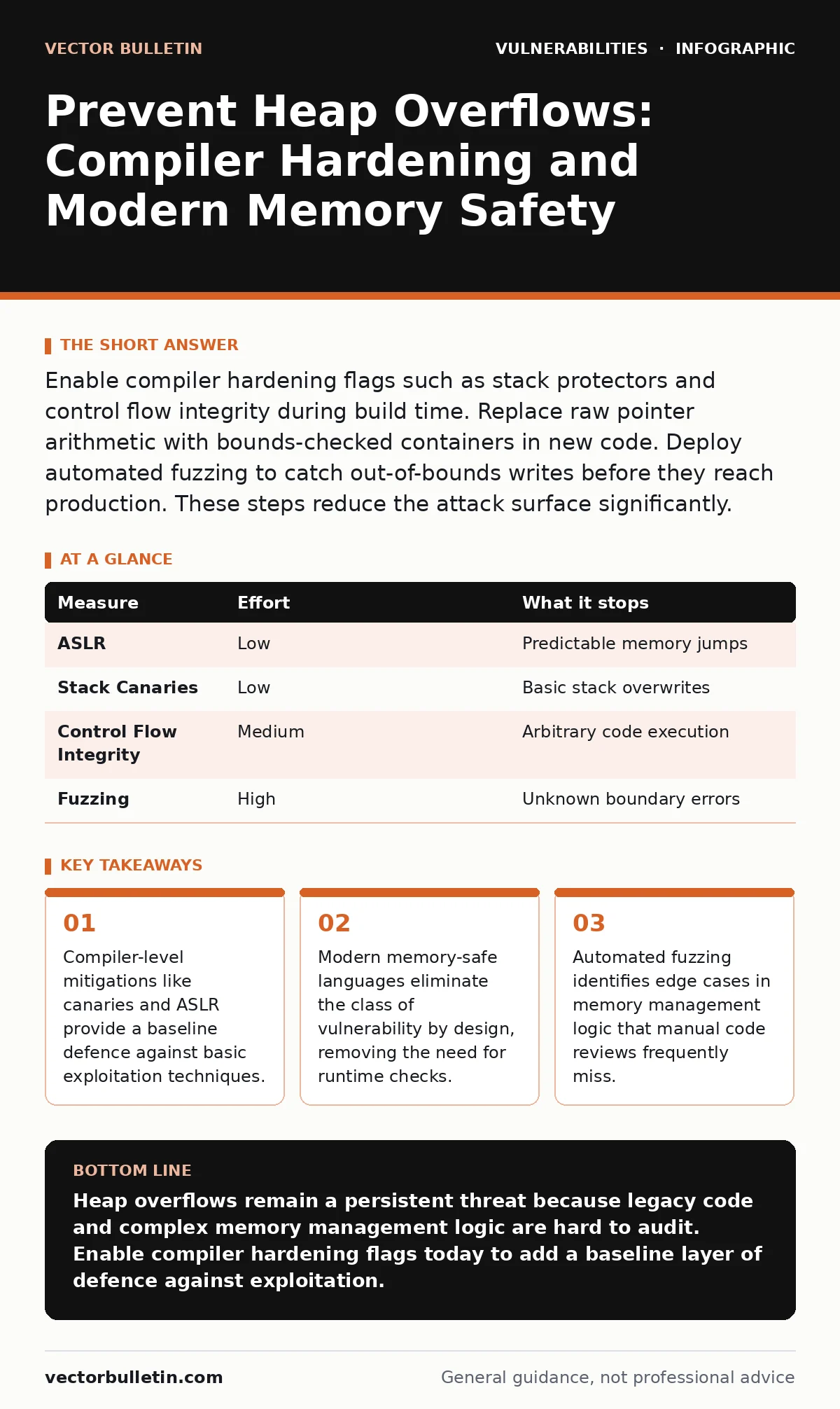
Enable compiler hardening flags such as stack protectors and control flow integrity during build time. Replace raw pointer arithmetic with bounds-checked containers in new code. Deploy automated fuzzing to catch out-of-bounds writes before they reach production. These steps reduce the attack surface significantly.
Prioritise compiler hardening flags first
You remove the most risk by configuring your build system to emit safer binaries. This step requires no code changes and protects existing legacy systems immediately. Modern compilers include several layers of defence that activate when you enable specific flags. These mitigations do not fix the underlying bug, but they make exploitation significantly harder.
Address space layout randomisation (ASLR) randomises the memory locations of key processes. This prevents attackers from predicting where to jump. Stack canaries place a known value before the return address on the stack. If an overflow overwrites this value, the program terminates before executing malicious code. Control flow integrity (CFI) restricts indirect calls to only valid targets. This stops attackers from hijacking execution flow even if they overwrite pointers.
| Measure | Effort | What it stops |
|---|---|---|
| ASLR | Low | Predictable memory jumps |
| Stack Canaries | Low | Basic stack overwrites |
| Control Flow Integrity | Medium | Arbitrary code execution |
| Fuzzing | High | Unknown boundary errors |
Adopt memory-safe languages for new development
The most effective long-term prevention is eliminating the ability to write out of bounds. Memory-safe languages like Rust or Go manage memory automatically. They enforce bounds checking at compile time or runtime. This removes the entire class of buffer overflow vulnerabilities from your codebase.
Legacy systems cannot always rewrite their core logic in a new language. You should isolate high-risk components, such as parsers or network handlers, into separate modules. Write these modules in a memory-safe language and communicate with the rest of the system via strict interfaces. This containment strategy limits the blast radius of any potential error.
This approach mirrors the lessons learned from Java deserialization vulnerabilities. Those flaws arose from trusting external data structures implicitly. Memory-safe languages treat all external data as untrusted by default. You gain security through language design rather than manual diligence.
Implement automated fuzzing in CI/CD
Manual code reviews miss subtle memory management errors. Developers often overlook edge cases in complex allocation logic. Fuzzing tools generate random or mutated inputs to crash the program. These crashes reveal memory corruption issues that static analysis tools cannot detect.
Integrate fuzzing into your continuous integration pipeline. Run fuzzers against functions that parse external data. Look for crashes that indicate out-of-bounds writes or use-after-free errors. Fix these issues before they merge into the main branch. This shifts security testing left in the development lifecycle.
Fuzzing is particularly effective for protocols and file formats. These inputs often have complex structures that trigger rare code paths. By stress-testing these parsers, you find vulnerabilities before attackers do. Combine fuzzing with security advisories to stay informed about known patterns in third-party libraries.
Audit third-party dependencies regularly
Your code is only as secure as its dependencies. Many heap overflows occur in widely used libraries rather than application code. These libraries may not receive timely updates or may have outdated build configurations.
Use software composition analysis tools to map your dependencies. Check for known vulnerabilities in these libraries. Ensure that your build process applies the same hardening flags to third-party code as it does to your own. Many vulnerabilities persist because developers link against libraries built without modern protections.
This practice aligns with maintaining strong vulnerability disclosure policies. When vendors disclose issues in their libraries, you need a process to respond quickly. Automated dependency scanning helps you identify affected components. You can then plan updates or apply temporary mitigations.
Replace raw pointers with safe abstractions
In C and C++, raw pointers allow direct memory access. This flexibility enables errors that lead to heap overflows. You should replace raw pointers with smart pointers or bounds-checked containers where possible. These abstractions enforce ownership and lifetime rules.
Standard library containers like std::vector in C++ perform automatic bounds checking. They prevent out-of-bounds access by throwing exceptions or asserting failures. This adds a small runtime cost but eliminates entire categories of bugs. You trade a negligible performance hit for significant security gains.
This strategy is similar to protecting against insecure direct object references (IDOR). In IDOR, you restrict access to resources by enforcing strict ownership checks. In memory safety, you restrict access to memory regions by enforcing strict allocation rules. Both approaches reduce the attack surface by limiting what an attacker can touch.
Disable unsafe legacy functions
Many older codebases use functions that do not check buffer sizes. Functions like strcpy or sprintf continue until they find a null terminator. This behaviour inevitably leads to overflows if the input is larger than the buffer.
Refactor code to use safer alternatives like strncpy or snprintf. These functions require you to specify the maximum number of characters to write. This forces the developer to consider buffer limits. It shifts the burden of safety from the runtime to the developer.
Monitor for exploitation attempts in production
Prevention is not perfect. You must detect when attackers attempt to exploit heap overflows in your live systems. Deploy runtime application self-protection (RASP) or intrusion detection systems that monitor for suspicious memory access patterns.
Look for signs of heap spraying. This technique involves filling memory with shellcode or gadgets. It is often a precursor to an overflow exploit. Detecting these patterns allows you to block attacks in real time. This is a defence-in-depth measure that complements your preventive controls.
This monitoring approach relates to how teams handle Windows privilege escalation vulnerabilities. Attackers often chain multiple issues to gain higher privileges. Detecting early stages of an attack chain can stop the entire process. You should treat memory corruption attempts as high-severity events.
Checklist for immediate action
You should implement these three steps today to reduce your risk profile. These actions require minimal effort but provide significant protection.
- Enable stack canaries and ASLR in your build configuration.
- Audit your top five third-party libraries for known heap vulnerabilities.
- Replace one critical raw pointer usage with a bounds-checked container.
Key takeaways
- Compiler-level mitigations like canaries and ASLR provide a baseline defence against basic exploitation techniques.
- Modern memory-safe languages eliminate the class of vulnerability by design, removing the need for runtime checks.
- Automated fuzzing identifies edge cases in memory management logic that manual code reviews frequently miss.
Heap overflows remain a persistent threat because legacy code and complex memory management logic are hard to audit. Enable compiler hardening flags today to add a baseline layer of defence against exploitation.
Frequently asked questions
Does ASLR prevent all heap overflow exploits?
No. ASLR randomises memory addresses but does not prevent buffer overflows. Attackers can use information leaks to bypass ASLR and exploit heap metadata.
Is static analysis enough to find heap overflows?
Static analysis is useful but often produces false positives or misses complex logic errors. You should combine it with dynamic testing methods like fuzzing for better coverage.
Can I fix heap overflows without rewriting code?
You can mitigate exploitation by enabling compiler hardening flags and deploying runtime protections. However, the only true fix is to correct the bounds checking logic in the source code.
Do memory-safe languages have any performance overhead?
Some memory-safe languages have minor runtime overhead due to bounds checking. However, modern optimisations often eliminate this cost, and the security benefits outweigh the performance impact.
How this guide was produced: written by the Vector Bulletin editorial team with AI assistance, checked against the public references listed below, and reviewed when the facts change. See our editorial policy or report an error.