JWT Implementation Mistakes That Break Authentication Security
Most JWT failures stem from incorrect algorithm validation or excessive token lifetimes rather than cryptographic weakness in the standard itself.
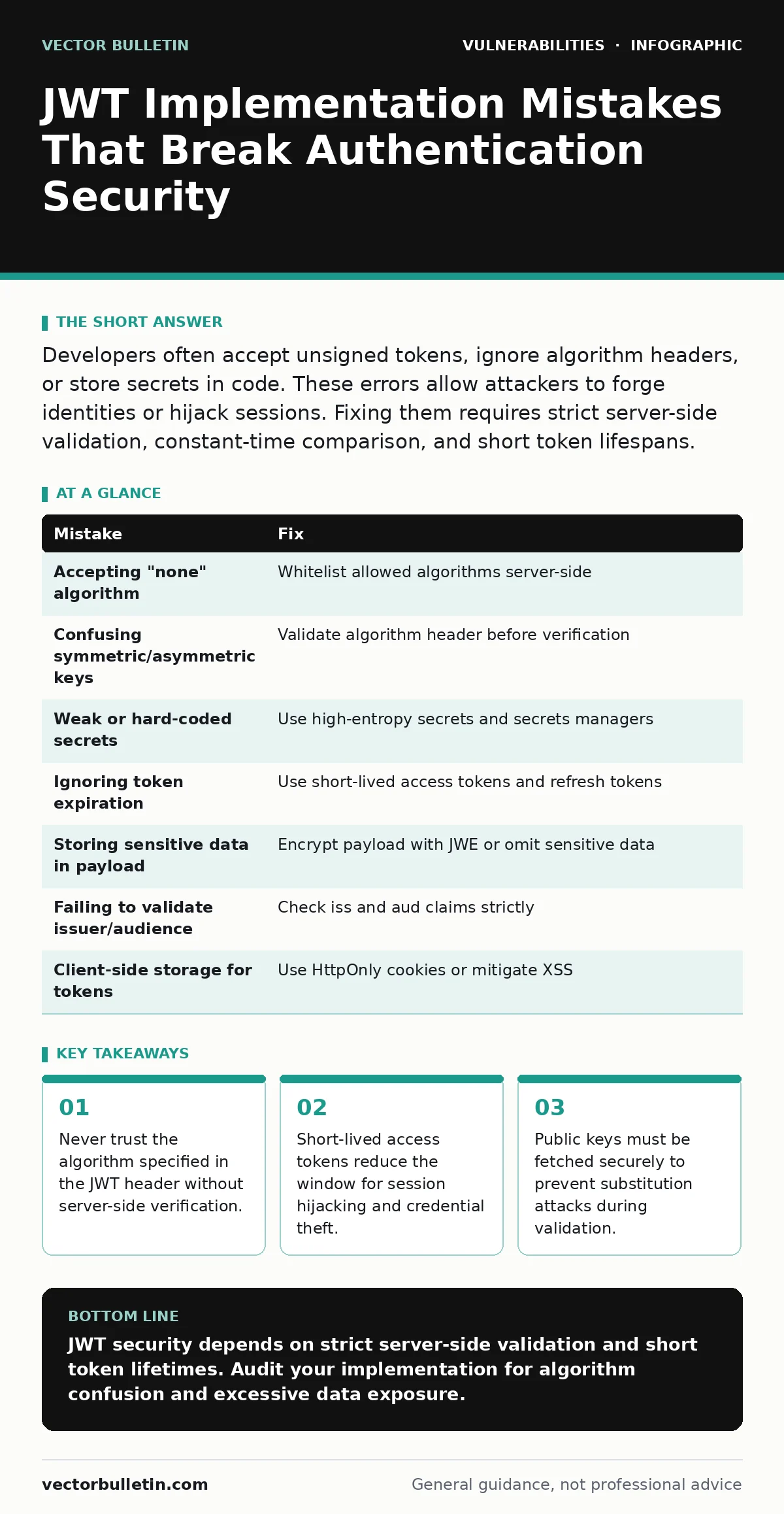
Developers often accept unsigned tokens, ignore algorithm headers, or store secrets in code. These errors allow attackers to forge identities or hijack sessions. Fixing them requires strict server-side validation, constant-time comparison, and short token lifespans.
Mistake 1: Accepting the "none" algorithm
Imagine a service that trusts the alg header in a JSON Web Token (JWT) without checking it against a whitelist. An attacker changes this header to none. The server sees this and skips signature verification. The attacker now holds a valid token for any identity they choose. This is not a bug in the library. It is a design flaw in how the application interprets standards.
Why it hurts:
The consequence is immediate and total identity compromise. An attacker can generate a token claiming to be any user, including administrators. The server accepts this token as authentic because it believes no signature is required. This bypasses all authentication logic downstream. It renders the entire security perimeter useless for that endpoint.
The fix:
Enforce a strict whitelist of allowed algorithms on the server side. Reject any token where the alg header does not match the expected value exactly. Do not rely on the client to specify the correct algorithm. The server must define the rules of engagement. This prevents algorithm confusion attacks where the attacker forces the server to use a weaker or non-existent validation method.
Mistake 2: Confusing symmetric and asymmetric keys
Suppose your application uses RSA for signing tokens. An attacker intercepts a token and changes the algorithm header to HS256. They then use your public RSA key as the HMAC secret. Since the public key is known, they can sign a new token. The server, seeing HS256, uses the same public key to verify the HMAC. The signature matches. The attacker is in.
Why it hurts:
This exploits the difference between symmetric and asymmetric cryptography. RSA keys are public. HMAC secrets must be private. When the server switches to a symmetric algorithm using a public key, the secret is no longer secret. This allows anyone with access to the public key to forge tokens. It turns a secure asymmetric system into a broken symmetric one.
The fix:
Validate the algorithm header before performing any verification. If the token claims to be RS256, verify it with RS256. Do not switch algorithms based on the header. If the expected algorithm is asymmetric, reject any symmetric algorithm claims. Ensure your cryptographic library does not allow automatic algorithm switching. Treat the algorithm as a constraint, not a suggestion.
Mistake 3: Using weak or hard-coded secrets
Developers sometimes use short strings or static values as signing secrets. Others embed these secrets directly in client-side JavaScript or mobile app binaries. These secrets are visible to anyone who inspects the code. An attacker extracts the secret and signs their own tokens. The server verifies them successfully because the secret matches.
Why it hurts:
The integrity of the token relies entirely on the secrecy of the signing key. If the key is exposed, the token is worthless as a security control. Hard-coded secrets cannot be rotated without redeploying the application. Weak secrets can be brute-forced if the entropy is low. Both scenarios lead to persistent unauthorized access. The breach is silent because the tokens appear valid.
The fix:
Generate high-entropy secrets using a cryptographically secure random number generator. Store secrets in environment variables or a secrets manager, never in source code. Rotate secrets regularly. If a secret is compromised, change it immediately and invalidate existing tokens. Use asymmetric keys for public-facing services to avoid sharing secrets with clients entirely.
Mistake 4: Ignoring token expiration
Some implementations issue tokens with very long lifetimes or no expiration at all. If an attacker steals such a token, it remains valid for days, weeks, or indefinitely. The user remains logged in even after they log out or change their password. The session is tied to the token, not the user's current state.
Why it hurts:
Long-lived tokens increase the impact of a data breach. Stolen tokens are valuable assets for attackers. They provide persistent access that is difficult to revoke. If the token is lost or stolen, the user cannot regain control of their account without a server-side revocation mechanism. This turns a temporary access grant into a permanent backdoor.
The fix:
Set short expiration times for access tokens, such as fifteen minutes. Use refresh tokens to obtain new access tokens. Refresh tokens can be revoked server-side if suspicious activity is detected. This limits the window of opportunity for an attacker. It also aligns with modern security standards that favour short-lived credentials.
Mistake 5: Storing sensitive data in clear text
JWTs are base64-encoded, not encrypted. Anyone with the token can decode the payload and read its contents. Developers sometimes store session IDs, email addresses, or internal user IDs in the payload. This information is visible to any intermediary or attacker who intercepts the token.
Why it hurts:
Exposing sensitive data in the payload violates privacy principles. It can aid attackers in crafting targeted attacks. Internal identifiers may reveal system architecture. Email addresses can be used for credential stuffing. The token becomes a source of intelligence for the attacker. It also creates compliance risks if regulated data is included.
The fix:
Treat the JWT payload as public information. Do not store secrets, passwords, or highly sensitive personal data in the token. Use the token to store non-sensitive claims like user roles or identifiers. If you must store sensitive data, encrypt the token using JSON Web Encryption (JWE). Ensure the encryption key is managed securely.
Mistake 6: Failing to validate the issuer and audience
Applications often skip checking the iss (issuer) and aud (audience) claims in the token. This allows tokens issued by other services or intended for other systems to be accepted. An attacker obtains a token from a less secure service and presents it to your service. Your service accepts it because it validates the signature but not the context.
Why it hurts:
This breaks the boundary between services. A token from a public-facing service should not grant access to an internal admin panel. If the audience is not validated, any token signed by the expected key is accepted. This allows cross-service token reuse. It undermines the principle of least privilege. The attacker gains access to resources they should not reach.
The fix:
Always validate the iss claim to ensure the token comes from a trusted authority. Validate the aud claim to ensure the token is intended for your service. Reject tokens that do not match these claims exactly. This ensures that tokens are used only in their intended context. It prevents token confusion attacks across microservices.
Mistake 7: Using client-side storage for sensitive tokens
Storing JWTs in localStorage or sessionStorage exposes them to cross-site scripting (XSS) attacks. If an attacker injects JavaScript into your page, they can read the storage and steal the token. Cookies with the HttpOnly flag are not accessible to JavaScript. This makes them safer against XSS.
Why it hurts:
XSS is a common vulnerability. If your application is vulnerable to XSS, storing tokens in JavaScript-accessible storage gives attackers direct access to authentication credentials. They can send the stolen token to their server. They then impersonate the user. The HttpOnly flag prevents JavaScript from reading the cookie, mitigating this risk.
The fix:
Store access tokens in HttpOnly cookies if possible. This prevents JavaScript from accessing the token. Ensure the cookie is marked as Secure to enforce HTTPS. Use SameSite attributes to prevent cross-site request forgery (CSRF). If you must use localStorage, ensure robust XSS protections are in place. This is a trade-off between convenience and security.
| Mistake | Fix |
|---|---|
| Accepting "none" algorithm | Whitelist allowed algorithms server-side |
| Confusing symmetric/asymmetric keys | Validate algorithm header before verification |
| Weak or hard-coded secrets | Use high-entropy secrets and secrets managers |
| Ignoring token expiration | Use short-lived access tokens and refresh tokens |
| Storing sensitive data in payload | Encrypt payload with JWE or omit sensitive data |
| Failing to validate issuer/audience | Check iss and aud claims strictly |
| Client-side storage for tokens | Use HttpOnly cookies or mitigate XSS |
Key takeaways
- Never trust the algorithm specified in the JWT header without server-side verification.
- Short-lived access tokens reduce the window for session hijacking and credential theft.
- Public keys must be fetched securely to prevent substitution attacks during validation.
JWT security depends on strict server-side validation and short token lifetimes. Audit your implementation for algorithm confusion and excessive data exposure.
Frequently asked questions
Can JWTs be encrypted?
Yes, using JSON Web Encryption (JWE) allows you to encrypt the token payload. This prevents anyone from reading the contents without the decryption key.
Should I use JWTs for session management?
JWTs are stateless, which simplifies scaling. However, they are harder to revoke than server-side sessions. Use short lifetimes and refresh tokens to mitigate this.
How do I prevent token theft?
Use HTTPS to prevent interception. Store tokens securely, preferably in `HttpOnly` cookies. Monitor for suspicious activity and revoke refresh tokens if needed.
Are JWTs vulnerable to replay attacks?
Yes, if the same token is used multiple times. Implement nonces or short expiration times to limit the window for replay. Track used tokens if necessary.
How this guide was produced: written by the Vector Bulletin editorial team with AI assistance, checked against the public references listed below, and reviewed when the facts change. See our editorial policy or report an error.