Hybrid Cyber Warfare: What Small Businesses Must Know
Small firms face state-level tactics because they offer low-risk access to larger supply chains and critical infrastructure.
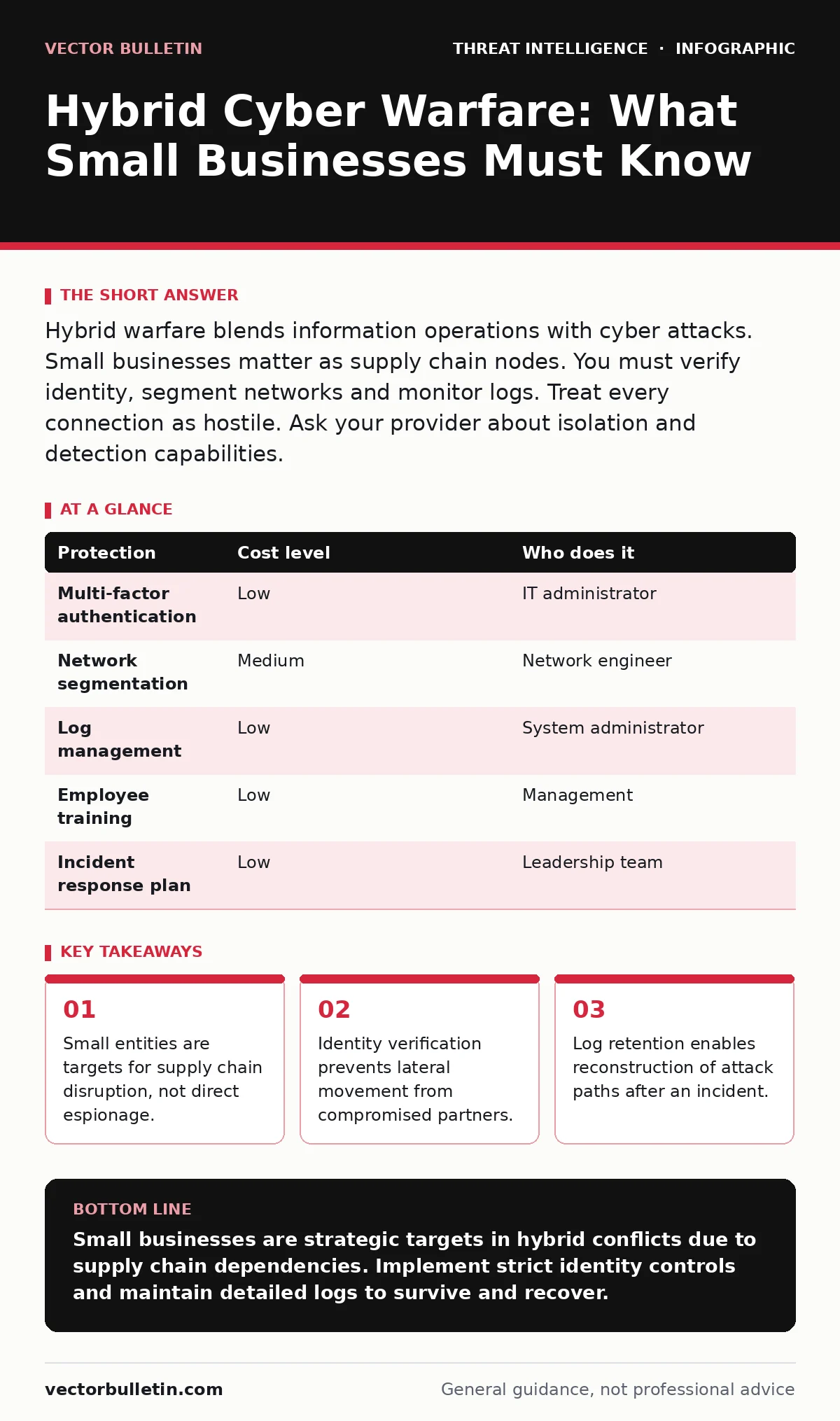
Hybrid warfare blends information operations with cyber attacks. Small businesses matter as supply chain nodes. You must verify identity, segment networks and monitor logs. Treat every connection as hostile. Ask your provider about isolation and detection capabilities.
EXAMPLE: The Ten-Person Logistics Firm
Imagine a ten-person logistics company that routes freight for major retailers. The firm uses standard email and cloud storage. A threat actor sends a convincing invoice request to the accounts clerk. The clerk pays an unknown vendor. Funds vanish. Simultaneously, the firm’s network is used to amplify a denial-of-service attack against a port authority. The firm suffers financial loss and reputational damage. It becomes a liability to its clients. The attack cost the actor nothing but time. The firm lacked basic identity checks. This scenario illustrates how small scale invites large scale consequences.
Why Small Scale Matters in Hybrid Conflicts
Hybrid warfare in cyberspace combines kinetic threats with digital disruption. States and non-state actors seek friction. They need leverage. Small businesses provide leverage through supply chain dependencies. A large manufacturer cannot operate if its small parts supplier goes offline. Attacking the small supplier is cheaper and less detectable. It creates cascading failure.
The attacker avoids direct confrontation with hardened targets. The small firm becomes a proxy battlefield. Its data is less valuable than its availability. Its connectivity is the weapon. This dynamic shifts the threat model. You are not targeted for your secrets. You are targeted for your position in the network. Understanding this changes your defence priorities. You must protect availability, not just confidentiality.
The Mechanics of Low-Intensity Cyber Pressure
Attackers use low-intensity methods to maintain plausible deniability. They employ open-source intelligence (OSINT) to map your digital footprint. They identify weak points in public records. They craft social engineering messages that appear legitimate. These messages exploit trust rather than technical flaws. A phishing email from a known partner bypasses technical filters. The recipient clicks a link. Malware installs silently. The system connects to a command and control server.
The attacker now has a foothold. They wait. They do not steal data immediately. They prepare for a coordinated strike. This patience is a hallmark of hybrid tactics. The goal is disruption at a specific moment. Timing is everything. The attack remains dormant until the political or economic context is favourable. This delays detection. It increases the impact when the trigger occurs. You must assume your systems are already compromised.
Practical Defences for Limited Resources
You cannot match state-level budgets with spending. You must match them with discipline. Start with identity management. Enforce multi-factor authentication on every account. This stops credential theft from succeeding. Most breaches begin with stolen passwords. MFA adds a layer that hackers cannot easily bypass. Next, implement network segmentation. Divide your network into zones. Limit communication between zones.
If one zone is compromised, the attacker cannot move freely. This containment reduces the blast radius. Use least privilege principles. Users should only have access to what they need. Administrators should not use admin accounts for daily tasks. These steps are cheap. They require configuration, not software. They force attackers to work harder. They buy you time. Time allows your team to detect and respond.
| Protection | Cost level | Who does it |
|---|---|---|
| Multi-factor authentication | Low | IT administrator |
| Network segmentation | Medium | Network engineer |
| Log management | Low | System administrator |
| Employee training | Low | Management |
| Incident response plan | Low | Leadership team |
What to Ask Your IT Provider
Your IT provider is your first line of defence. You must verify their capabilities. Do not accept vague assurances. Ask specific questions. Demand clear answers. If they cannot answer, change providers. The market has many options. You need a partner who understands hybrid threats. They should proactively suggest improvements. They should not wait for you to ask. Your relationship should be transparent. You need to know what they monitor. You need to know what they miss. This dialogue builds trust. It ensures alignment of goals. It prepares you for the inevitable breach. No system is perfect. Preparation is key.
- How do you detect lateral movement within our network?
- What is your process for verifying identity anomalies?
- How long do you retain logs for forensic analysis?
- Can you simulate an attack to test our defences?
- What is your response time for critical alerts?
See also: Lateral Movement Response: Containment, Recovery and Prevention Steps · What Is the Cyber Kill Chain: A Structural Breakdown of Attack Phases
The Hidden Cost of Complacency
Many small firms believe they are too small to notice. This belief is dangerous. It leads to neglect. Neglect leads to vulnerability. Attackers scan for negligence. They look for unpatched systems. They look for default passwords. They look for exposed services. These are easy wins. They require little effort. The cost of fixing them is low. The cost of a breach is high. Downtime costs money.
Reputation costs clients. Legal fees drain resources. The hidden cost is the loss of control. You become a pawn in a larger game. You lose your operational independence. Your partners may drop you. Your insurance may not cover the loss. The financial impact extends beyond the immediate loss. It affects future growth. It limits your ability to compete. Security is an investment in continuity.
Log Management and Forensic Readiness
Logs are your memory. They record every action on your systems. Without logs, you are blind. You cannot reconstruct an attack. You cannot prove who did what. You cannot identify the scope. Log management involves collecting, storing and analysing these records. You must ensure logs are tamper-proof. Store them off-site. Use a secure protocol. Retain them for a sufficient period. Six months is a minimum.
One year is better. This retention allows for retrospective analysis. It helps identify patterns. It supports legal proceedings. It improves future defences. Logs are useless if you cannot read them. Train your team to interpret them. Use tools that simplify analysis. Automate alerting for suspicious activity. This turns data into intelligence. It reduces response time. It increases confidence.
Integrating Threat Intelligence into Operations
Threat intelligence tells you what is happening outside. It informs your internal defences. You do not need expensive feeds. Free sources provide valuable data. Monitor security forums. Follow industry alerts. Subscribe to advisories. Look for trends in attack methods. Map these to your environment. Use frameworks like the MITRE ATT&CK Navigator to understand tactics. This framework categorises attacker behaviours.
It helps you identify gaps. It allows you to prioritise defences. Focus on high-impact, low-effort attacks. These are the most common. They are also the easiest to block. Integrate this knowledge into your daily operations. Update your rules. Adjust your filters. Train your staff. This continuous improvement keeps you ahead. It ensures you are not fighting last year’s war.
Key takeaways
- Small entities are targets for supply chain disruption, not direct espionage.
- Identity verification prevents lateral movement from compromised partners.
- Log retention enables reconstruction of attack paths after an incident.
Small businesses are strategic targets in hybrid conflicts due to supply chain dependencies. Implement strict identity controls and maintain detailed logs to survive and recover.
Frequently asked questions
Is hybrid warfare only for large corporations?
No. Small businesses are targeted to disrupt supply chains and create cascading failures in larger networks.
How do I detect if I am part of a hybrid attack?
Look for unusual network traffic, failed login attempts and unexpected system changes. Monitor logs closely.
What is the role of open-source intelligence?
OSINT helps you understand attacker tactics and trends without expensive tools. It informs your defensive posture.
Can insurance cover hybrid attack damages?
Coverage varies. Most policies exclude intentional acts or war. Read your policy carefully and disclose risks.
How this guide was produced: written by the Vector Bulletin editorial team with AI assistance, checked against the public references listed below, and reviewed when the facts change. See our editorial policy or report an error.