
Session Hijacking Definition: How Token Theft Bypasses Login Controls
Attackers steal active session tokens to access accounts without credentials, rendering traditional login security measures ineffective for that duration.
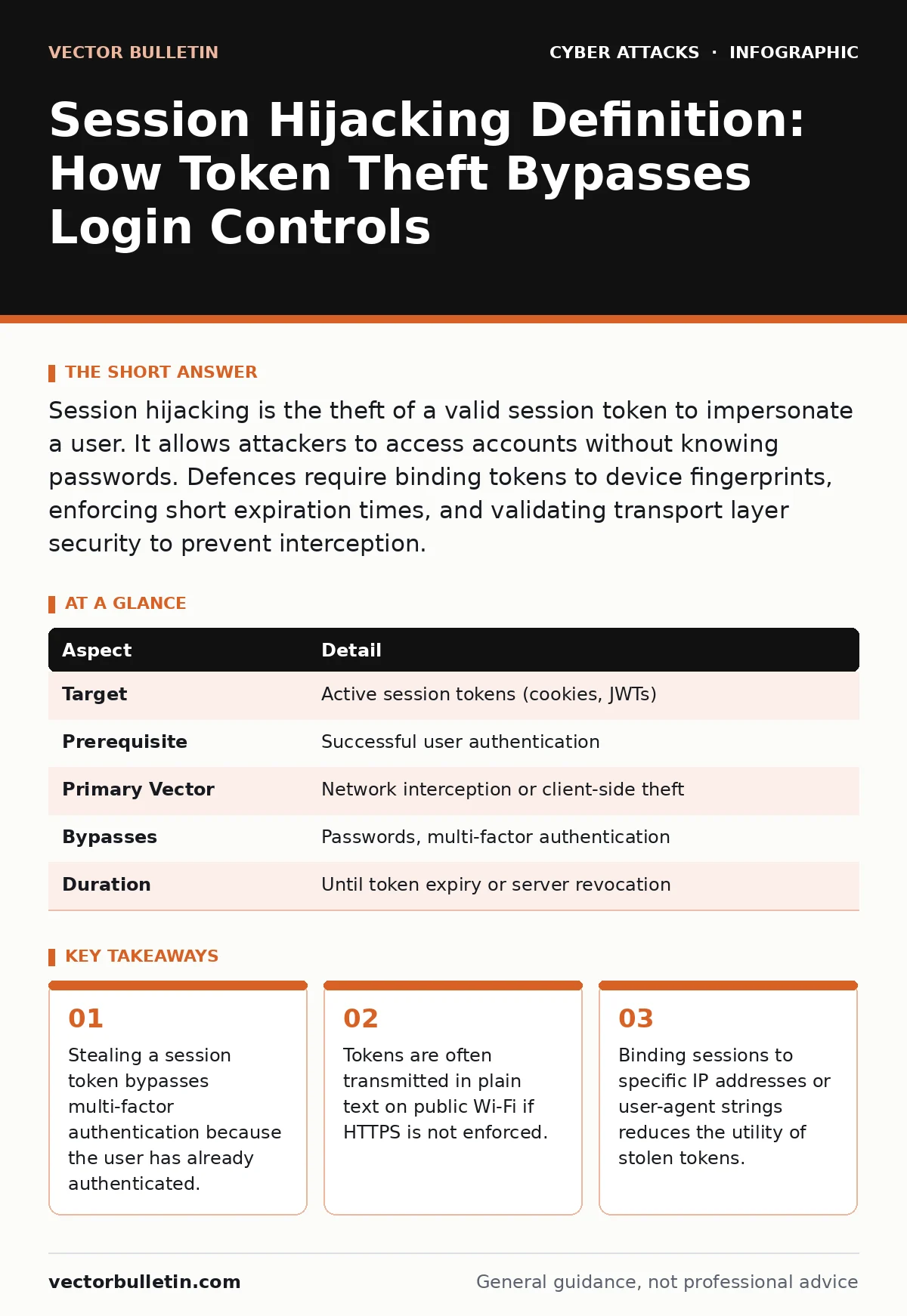
Session hijacking is the theft of a valid session token to impersonate a user. It allows attackers to access accounts without knowing passwords. Defences require binding tokens to device fingerprints, enforcing short expiration times, and validating transport layer security to prevent interception.
The Library Card Analogy
Imagine you borrow a library card. The librarian checks your ID once at the desk. After that, you just show the card to enter restricted areas. Session hijacking is equivalent to someone stealing your card while you are inside. They do not need your ID or your PIN. They only need the physical card. The system trusts the card, not the person holding it. This distinction explains why protecting the login phase is insufficient. The threat exists after authentication succeeds. Security teams often focus heavily on the initial handshake. This leaves the longer session window vulnerable. The token represents trust, not identity. Once stolen, that trust is misused.
What Is Session Hijacking Definition
Session hijacking definition refers to the compromise of a valid user session to gain unauthorised access to a system. It occurs after a user has successfully authenticated. The attacker steals the session identifier, known as a token. This token acts as a temporary key. It proves to the server that the holder is the authenticated user. The server does not re-verify credentials during the session. It relies on the token's validity. This design improves performance but introduces a single point of failure. If the token is exposed, the attacker assumes the user's privileges. The session remains active until it expires or is terminated.
| Aspect | Detail |
|---|---|
| Target | Active session tokens (cookies, JWTs) |
| Prerequisite | Successful user authentication |
| Primary Vector | Network interception or client-side theft |
| Bypasses | Passwords, multi-factor authentication |
| Duration | Until token expiry or server revocation |
How Token Theft Occurs
Attackers acquire tokens through several established mechanisms. Network sniffing remains a common method on unsecured connections. When data travels in plain text, anyone on the same network segment can read it. Cross-site scripting is another frequent vector. Malicious scripts injected into a web page can read cookies from the user's browser. These scripts send the token to a remote server controlled by the attacker.
Man-in-the-middle attacks exploit weak encryption or certificate errors. The attacker sits between the user and the server. They decrypt, read, and re-encrypt traffic. This allows real-time token capture. Fixation attacks trick users into using a known token. The attacker sets the token value before the user logs in. When the user authenticates, the server accepts the attacker's chosen token.
Who Is Affected by Token Theft
This threat affects any system that uses stateful sessions. Web applications are the primary target. They rely on cookies to maintain user state across multiple page requests. Mobile applications are equally vulnerable. They often store tokens in local storage or keychains. If the device is compromised, the token is exposed. Single sign-on systems amplify the risk. A stolen token from one service may grant access to others.
Privileged accounts face higher consequences. An attacker with admin rights can alter configurations or exfiltrate data. The impact is not limited to individuals. Organisations suffer from data breaches and reputational damage. The cost of incident response is significant. Recovery requires resetting credentials and revoking sessions. This disrupts legitimate user activity.
Common Misconceptions About Session Security
Many organisations believe that strong passwords prevent session hijacking. This is incorrect. Passwords protect the initial login. They do not protect the session token. Once the token is issued, the password is irrelevant. Multi-factor authentication also fails to stop hijacking. MFA verifies identity at login. It does not verify identity during the session. If the token is stolen, MFA is bypassed. Another mistake is assuming HTTPS solves all problems.
HTTPS protects data in transit. It does not protect tokens stored on the client device. If malware infects the browser, HTTPS cannot help. Teams often neglect token expiration policies. Long-lived tokens increase the window of opportunity. They give attackers more time to act. Short expiration times reduce this risk. They force users to re-authenticate frequently. This adds friction but improves security.
See also: Why is SPF so important for email security
Defending Against Token Theft
Defence requires a layered approach. Transport layer security is the first line. All traffic must use HTTPS. This prevents network sniffing. Certificate pinning adds another layer. It ensures the client connects to the correct server. This mitigates man-in-the-middle attacks. Token binding is a powerful technique. It links the token to specific device attributes. These attributes include IP address and user-agent string. If the token is used from a different device, the server rejects it.
This limits the usefulness of stolen tokens. However, it can cause issues for users with dynamic IPs. Short session lifetimes reduce exposure. Tokens should expire quickly. Refresh tokens allow seamless renewal. They are stored more securely than access tokens. Regular rotation of refresh tokens limits damage. If a token is stolen, it becomes invalid after use. This is known as one-time use. It forces the attacker to steal a new token.
Operational Controls for Security Teams
Security operations teams must monitor for anomalous session behaviour. Sudden changes in IP location are a red flag. Access from multiple devices simultaneously indicates theft. User-agent mismatches suggest token reuse. Automated systems can detect these patterns. They can terminate suspicious sessions. This requires real-time analysis. Logging must capture session start and end times. It must record IP addresses and device fingerprints.
Correlating logs helps identify hijacking attempts. Incident response plans must include session revocation. Administrators need a way to kill all sessions for a user. This stops the attacker immediately. It forces the user to log in again. This action should be documented. It provides an audit trail. Training users is also necessary. They must recognise signs of compromise. Phishing emails often precede token theft. Users should report suspicious activity promptly.
Related Security Concepts
Understanding session hijacking requires context. It is part of the broader attack lifecycle. Attackers move from reconnaissance to exploitation. Token theft is an exploitation step. It follows initial access. It precedes lateral movement. Protecting against it is part of cyber hygiene. Good hygiene includes patching software and updating configurations. It also involves reviewing access controls. Privileged access management helps limit the damage. If an admin token is stolen, the impact is severe.
PAM solutions monitor and control admin sessions. They can detect unusual activity. They can terminate sessions remotely. This reduces the blast radius. While BGP hijacking affects network routing, session hijacking affects application layer trust. Both involve interception. But they operate at different levels. Understanding the difference helps prioritise defences. DDoS protection focuses on availability. Session hijacking focuses on confidentiality and integrity. They are distinct but related concerns.
Key takeaways
- Stealing a session token bypasses multi-factor authentication because the user has already authenticated.
- Tokens are often transmitted in plain text on public Wi-Fi if HTTPS is not enforced.
- Binding sessions to specific IP addresses or user-agent strings reduces the utility of stolen tokens.
Frequently asked questions
Can 2FA prevent session hijacking?
No, 2FA only secures the initial login. Once the session token is issued, 2FA is bypassed. The attacker uses the valid token to access the account.
How long should a session token last?
Tokens should expire quickly, often within minutes. Refresh tokens can extend the session securely. This limits the window for attackers to use stolen tokens.
Does HTTPS stop session hijacking?
HTTPS prevents network sniffing but not client-side theft. Malware or cross-site scripting can still steal tokens. Additional measures like HttpOnly cookies are needed.
What is the difference between session hijacking and session fixation?
Hijacking involves stealing an existing token. Fixitation involves forcing a user to use a known token. Both result in unauthorised access but use different methods.
How this guide was produced: written by the Vector Bulletin editorial team with AI assistance, checked against the public references listed below, and reviewed when the facts change. See our editorial policy or report an error.