
SPF Misconceptions: Why Your Records Fail and How to Fix Them
SPF validation stops at the final hop, leaving your domain vulnerable to spoofing once mail traverses third-party servers.
SPF only verifies the sending IP address against a published list of authorised hosts. It does not validate the message content, the return path header, or the envelope sender beyond the initial transmission. Misunderstanding these limits leads to false confidence in email authentication.
Misreading: SPF validates the entire email message
Correct reading: SPF only checks the envelope sender address against the domain's published DNS record. It confirms that the server initiating the connection is authorised to send mail for that domain. It does not inspect the message body, the subject line, or the "From:" header visible to the recipient. An attacker can craft a message with a legitimate-looking header while using an unauthorised server. The SPF record remains unchanged and passes validation for the envelope sender, even if the content is malicious. This separation means SPF alone cannot prevent sophisticated phishing attacks that mimic branding.
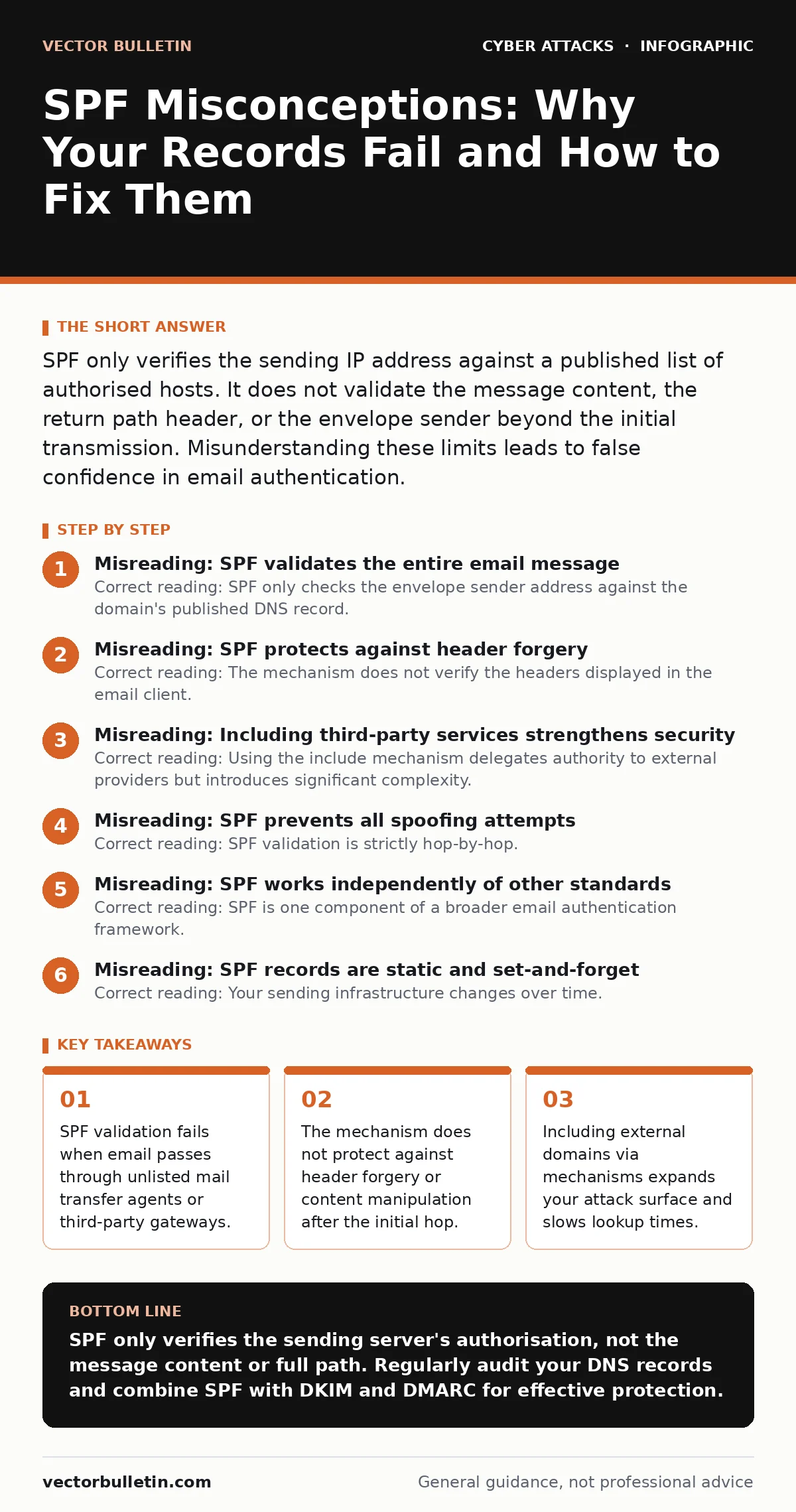
Misreading: SPF protects against header forgery
Correct reading: The mechanism does not verify the headers displayed in the email client. Attackers frequently alter the "From:" field to display a trusted name while using a different envelope sender. SPF validation occurs at the transport layer, checking the IP address of the connecting server. It has no visibility into the presentation layer headers. Recipients see the forged header, not the technical envelope data. Without additional controls, users trust the visible sender information. This gap allows spammers to bypass SPF checks by ensuring the envelope sender aligns with their own infrastructure while spoofing the display name.
Misreading: Including third-party services strengthens security
Correct reading: Using the include mechanism delegates authority to external providers but introduces significant complexity. Each include directive triggers a separate DNS lookup. Excessive includes increase the risk of exceeding the 10-lookup limit, causing validation failures. More critically, you inherit the security posture of included domains. If a third-party provider suffers a breach or misconfiguration, their servers may send mail on your behalf. You cannot control their access policies. This creates a hidden dependency where your reputation relies on the security hygiene of vendors you do not manage.
Misreading: SPF prevents all spoofing attempts
Correct reading: SPF validation is strictly hop-by-hop. It only verifies the final server that delivers the mail to the recipient's inbox. If an email passes through an intermediate mail transfer agent not listed in your SPF record, validation fails at that hop. However, if the final delivering server is authorised, the check passes. Attackers exploit this by routing mail through open relays or compromised servers that are inadvertently listed as authorised. The mechanism cannot trace the full path of the message. It assumes the last hop is trustworthy based on DNS records, ignoring the journey taken to reach that point.
Misreading: SPF works independently of other standards
Correct reading: SPF is one component of a broader email authentication framework. It must be combined with DomainKeys Identified Mail (DKIM) and DMARC to provide meaningful protection. DKIM signs the message content, ensuring it has not been altered in transit. DMARC provides policy instructions on how to handle messages that fail SPF or DKIM checks. Relying on SPF alone leaves gaps where header mismatches or forwarding can cause false positives or negatives. A holistic approach requires all three standards to work together. This integration ensures that both the sender identity and message integrity are verified.
See also: Difference Between Cyber Hygiene and Cyber Security: Scope and Execution
Misreading: SPF records are static and set-and-forget
Correct reading: Your sending infrastructure changes over time. New marketing platforms, transactional email services, and internal servers require updates to your SPF record. Failing to update the record causes legitimate mail to be rejected. Conversely, leaving old entries in place increases the attack surface. Each entry is a potential entry point for abuse. Regular maintenance is required to align the DNS record with your current operational reality. This dynamic nature means SPF management is an ongoing process, not a one-time configuration. Neglecting updates leads to deliverability issues and security gaps.
Misreading: SPF provides complete email security
Correct reading: No single mechanism offers absolute protection. SPF addresses the source IP verification but leaves other vectors open. Users must also consider other aspects of their security posture. For instance, privileged access management ensures that internal systems used for email transmission are secured against compromise. Without proper access controls, attackers can gain entry to authorised sending servers. This renders SPF useless because the mail originates from a legitimate, authorised source. Security is layered, and email authentication is just one layer.
Key takeaways
- SPF validation fails when email passes through unlisted mail transfer agents or third-party gateways.
- The mechanism does not protect against header forgery or content manipulation after the initial hop.
- Including external domains via mechanisms expands your attack surface and slows lookup times.
- SPF works in tandem with DKIM and DMARC to provide a complete verification picture.
SPF only verifies the sending server's authorisation, not the message content or full path. Regularly audit your DNS records and combine SPF with DKIM and DMARC for effective protection.
Frequently asked questions
Why does my SPF check fail when I forward email?
Forwarding often changes the envelope sender or adds the forwarding server as a new hop. If the forwarding server is not in your SPF record, validation fails.
Can I use SPF to block spam entirely?
No. SPF only verifies sender authorisation. Spammers can use domains with poor SPF policies or spoof domains that do not use SPF at all.
How many DNS lookups are allowed in an SPF record?
The standard limits SPF records to 10 DNS lookups. Exceeding this limit causes validation to fail, resulting in rejected mail.
Does SPF protect against business email compromise?
SPF helps verify the sending server but does not prevent sophisticated social engineering attacks. Attackers can use authorised servers or domains with weak policies.
How this guide was produced: written by the Vector Bulletin editorial team with AI assistance, checked against the public references listed below, and reviewed when the facts change. See our editorial policy or report an error.