
Detect AI Model Theft: Signals in Logs, Systems and Behaviour
Model theft often leaves no malware traces, only anomalous inference patterns and resource spikes that standard security tools ignore entirely.
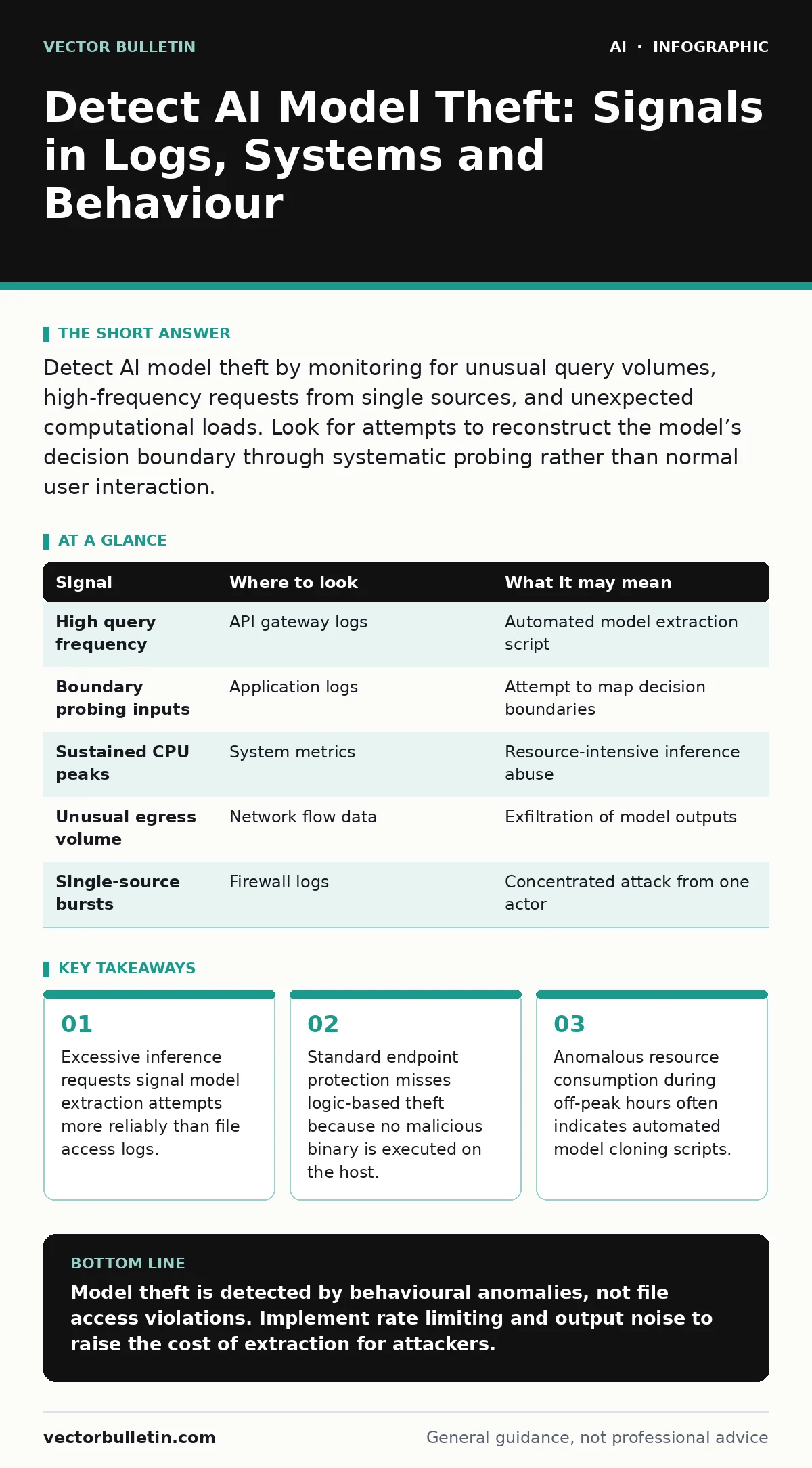
Detect AI model theft by monitoring for unusual query volumes, high-frequency requests from single sources, and unexpected computational loads. Look for attempts to reconstruct the model’s decision boundary through systematic probing rather than normal user interaction.
The Mechanics of Model Extraction
Model theft rarely involves stealing a file from a disk. Instead, attackers treat the AI service as an oracle. They send carefully crafted inputs and record the outputs. By analysing these pairs, they reconstruct the model’s internal logic. This process is known as model extraction. It does not require access to the underlying code or weights. It only requires the ability to query the model repeatedly. The attacker builds a surrogate model that mimics the original’s behaviour. The stolen model may not be identical, but it performs the same function. This means the intellectual property is compromised without any traditional breach indicators.
Inference Endpoint Anomalies
The most visible sign of theft occurs at the inference endpoint. This is the interface where users submit data to the model. Normal usage patterns show variation in query complexity and timing. Attackers seeking to extract a model behave differently. They send high volumes of simple, structured queries. These queries are designed to map the decision boundaries of the neural networks. You will see a spike in requests that deviates from historical baselines. The requests often come from a limited number of source addresses. These addresses may rotate, but the query patterns remain rigid. Monitor for bursts of activity that lack the randomness of human interaction.
Computational Resource Spikes
Model extraction is computationally expensive for the victim. Each query requires the model to process data and generate a response. When an attacker floods the endpoint, the system consumes more CPU and memory. This consumption happens even if the queries are small. The model must still execute its internal calculations. You may notice increased latency for legitimate users. This degradation is a side effect of the theft attempt. Check your resource utilisation metrics for sustained peaks. These peaks often occur during off-peak hours when monitoring is lax. The attacker aims to maximise throughput while minimising detection risk.
Data Egress and Network Traffic
The attacker must transfer the stolen information out of your environment. This transfer happens through the responses sent back to the client. While individual responses may seem benign, the aggregate data volume increases. Look for unusual outbound traffic patterns from the inference server. The traffic may be encrypted, hiding the content. However, the volume and timing can still be anomalous. Compare current egress rates against established baselines. A sudden increase in data leaving the AI service is a red flag. This traffic carries the output data used to train the surrogate model. Blocking or rate-limiting excessive egress can disrupt the theft.
Application Layer Logs
Standard web server logs often miss the nuance of AI attacks. You need to inspect application-layer logs specifically. These logs record the inputs submitted to the model and the outputs generated. Look for inputs that test edge cases. An attacker will probe the model with boundary values. They try to find the exact point where the model’s prediction changes. This behaviour is distinct from normal user queries. Normal users seek answers, not boundaries. Automated scripts leave a trail of systematic probing. Analyse the distribution of input values. A uniform distribution suggests automated testing rather than organic usage.
| Signal | Where to look | What it may mean |
|---|---|---|
| High query frequency | API gateway logs | Automated model extraction script |
| Boundary probing inputs | Application logs | Attempt to map decision boundaries |
| Sustained CPU peaks | System metrics | Resource-intensive inference abuse |
| Unusual egress volume | Network flow data | Exfiltration of model outputs |
| Single-source bursts | Firewall logs | Concentrated attack from one actor |
Common Blind Spots in Detection
Many security teams focus on file integrity and access controls. This focus is a blind spot for AI model theft. The model weights are never touched. The theft happens through the API. Another blind spot is the assumption that anonymised data prevents theft. Attackers do not need personal data to steal the model logic. They only need the input-output pairs. Additionally, standard intrusion detection systems look for known malware signatures. Model extraction leaves no signature. It looks like normal application traffic. You must treat the AI service as a separate attack surface. Apply specific monitoring rules to this surface.
Mitigating Extraction Risks
Mitigation requires limiting the information an attacker can gather. Add noise to the model’s outputs. This technique, known as output perturbation, makes it harder to reconstruct the original logic. The noise reduces the accuracy of the surrogate model. Another measure is to limit the precision of the outputs. Rounding probabilities reduces the information available to the attacker.
Combine these technical measures with behavioural monitoring. Detect and block anomalous query patterns. Consider the trade-offs carefully. Adding noise may reduce the model’s utility for legitimate users. Balancing security and performance is a continuous process. Refer to guides on securing AI agents for broader architectural strategies.
Integrating with Security Operations
Integrate AI monitoring into your existing security operations. Feed inference logs into your SIEM. Create alerts for the anomalies described above. Correlate these alerts with other security events. Model theft may be part of a larger campaign. Look for connections to other activities like sensitive data leaks through AI chatbots. Understanding the broader context helps prioritise responses. Ensure your team understands the concept of machine learning in cybersecurity. This knowledge helps distinguish between attack and anomaly. Regularly update your detection rules. Attackers adapt their methods to evade static thresholds.
Key takeaways
- Excessive inference requests signal model extraction attempts more reliably than file access logs.
- Standard endpoint protection misses logic-based theft because no malicious binary is executed on the host.
- Anomalous resource consumption during off-peak hours often indicates automated model cloning scripts.
Model theft is detected by behavioural anomalies, not file access violations. Implement rate limiting and output noise to raise the cost of extraction for attackers.
Frequently asked questions
How do I distinguish between a DDoS attack and model theft?
DDoS attacks aim to exhaust resources with invalid or minimal requests. Model theft uses valid, structured queries to gather specific output data for reconstruction.
Can encryption prevent model extraction?
Encryption protects data in transit but does not hide the input-output relationship. Attackers observe the plaintext queries and responses at the endpoint.
What is the difference between model theft and data poisoning?
Model theft copies the existing logic. Data poisoning corrupts the training data to alter future behaviour. Theft is exfiltration; poisoning is manipulation.
Should I disable the API if I suspect theft?
Disabling the API may disrupt legitimate business operations. Instead, implement strict rate limiting and monitor closely to contain the attack.
How this guide was produced: written by the Vector Bulletin editorial team with AI assistance, checked against the public references listed below, and reviewed when the facts change. See our editorial policy or report an error.