
Securing AI Agents: Seven Common Mistakes and Fixes
AI agents inherit systemic vulnerabilities from their underlying models, creating attack surfaces that traditional perimeter defenses cannot detect or block effectively.
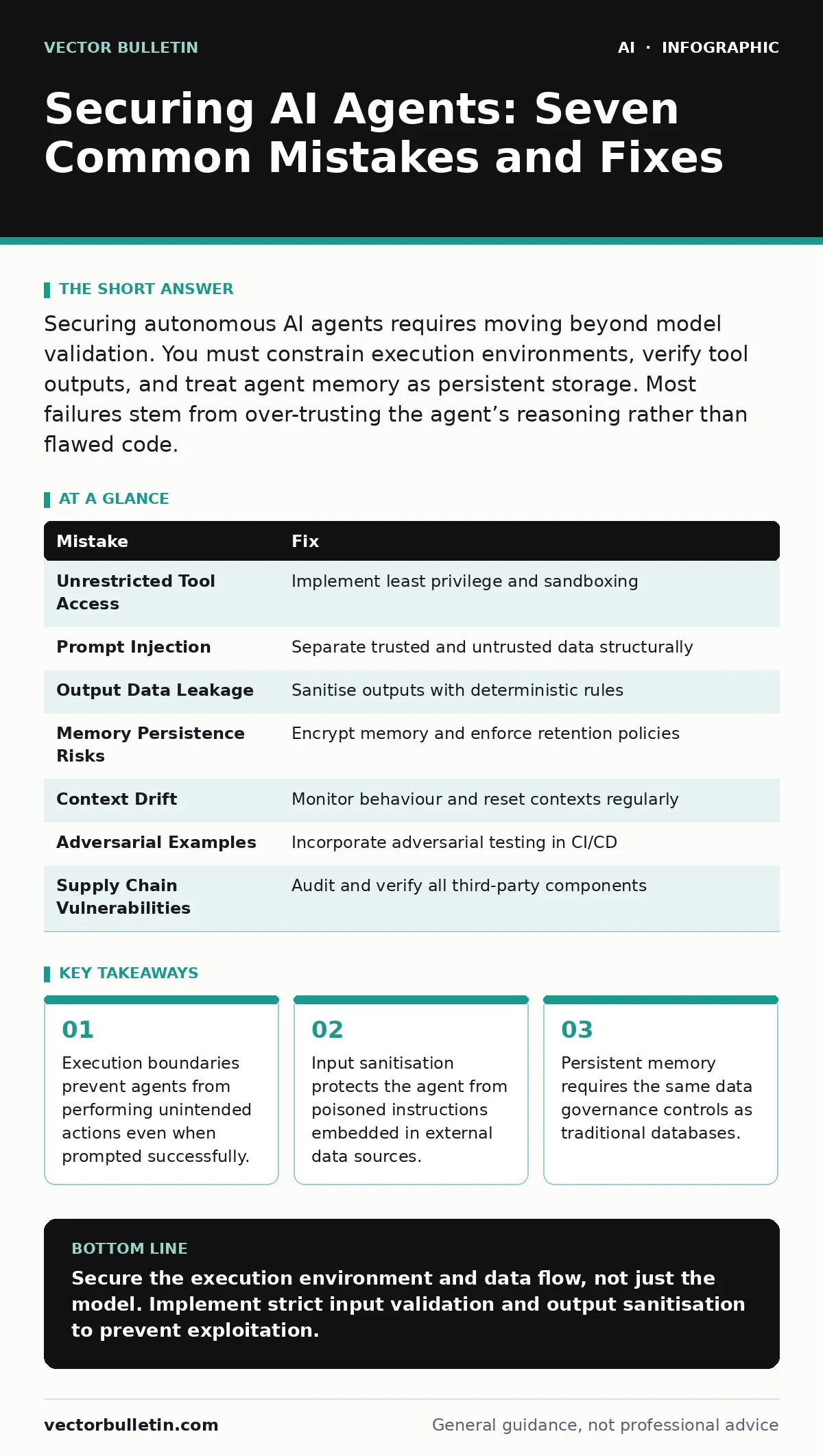
Securing autonomous AI agents requires moving beyond model validation. You must constrain execution environments, verify tool outputs, and treat agent memory as persistent storage. Most failures stem from over-trusting the agent’s reasoning rather than flawed code.
Mistake 1: Granting Unrestricted Tool Access
Autonomous agents rely on tools to interact with external systems. A common error is granting the agent broad permissions to execute commands, write files, or access databases without granular restrictions. The agent operates within a context window that includes your instructions and its own reasoning. If an attacker manipulates that reasoning, the agent will use its tools to amplify the exploit. This turns a text-based interaction into a direct pathway for system compromise.
Why it hurts:
The agent acts as a privileged bridge between natural language and system execution. Without strict boundaries, a successful prompt injection allows the attacker to run arbitrary code or exfiltrate data using the agent’s credentials. The damage scales with the permissions granted, not just the sophistication of the attack.
The fix:
Implement the principle of least privilege at the tool integration layer. Each tool should operate with only the permissions necessary for its specific function. Use sandboxed environments for execution and separate identity tokens for data access. For deeper technical frameworks, review MITRE ATLAS for structured threat modelling of these autonomous systems.
Mistake 2: Ignoring Prompt Injection Vectors
Developers often focus on securing the model weights while neglecting the input stream. Agents that process untrusted data from emails, websites, or APIs are vulnerable to prompt injection. An attacker embeds malicious instructions within the data the agent is meant to process. The model, following its core directive to be helpful, prioritises these hidden instructions over your original system prompt. This bypasses content filters that rely solely on output analysis.
Why it hurts:
The agent’s context window blends trusted system instructions with untrusted user or external data. When these boundaries blur, the agent cannot distinguish between its primary task and an injected command. This leads to data leakage, unwanted actions, or the agent acting as a proxy for further attacks.
The fix:
Separate trusted instructions from untrusted data using structural delimiters and explicit parsing rules. Validate all external inputs before they enter the agent’s context. Treat every piece of external data as potentially hostile. Consider the risks of sensitive data leaks through AI chatbots when designing these input pipelines.
Mistake 3: Failing to Sanitise Output Data
Agents often retrieve information to answer queries or complete tasks. If the agent displays raw data from internal databases or documents without sanitisation, it exposes sensitive information. This is particularly risky when the agent summarises or rephrases content, as it may inadvertently include confidential details in the output. The assumption that the model will "know" what is confidential is unreliable.
Why it hurts:
The model lacks inherent knowledge of your specific data classification policies. It follows patterns learned during training, not your organisational rules. This results in accidental disclosure of personally identifiable information, intellectual property, or trade secrets through seemingly innocuous summaries or responses.
The fix:
Implement a post-processing layer that scans agent outputs for sensitive patterns before they reach the user. Use deterministic rules rather than relying on the model to self-censor. Define clear data handling policies for the agent and enforce them programmatically.
Mistake 4: Overlooking Agent Memory Persistence
Many agents maintain memory to improve performance over time. This memory often includes conversation history, learned preferences, or cached results. If this memory is not secured, it becomes a repository for sensitive data. Attackers can query the agent to extract previously processed information, bypassing current session restrictions. The persistence of memory turns transient interactions into long-term data liabilities.
Why it hurts:
Memory vectors allow attackers to reconstruct sensitive information from fragmented interactions. If the memory store is not encrypted or access-controlled, any compromise of the agent interface leads to full data exposure. This violates data minimisation principles and complicates compliance efforts.
The fix:
Treat agent memory as a database. Encrypt stored memories at rest and in transit. Implement strict access controls and retention policies. Regularly audit the memory store for sensitive data that should have been deleted. For related insights on data handling, refer to our guide on AI transparency.
Mistake 5: Assuming Model Immutability
Teams often assume that once a model is deployed, its behaviour is fixed. However, agents can be influenced by their environment and previous interactions. This is known as context drift. The agent may gradually shift its behaviour away from the original instructions due to accumulated biases or manipulated inputs. This drift can introduce vulnerabilities that were not present in the initial model.
Why it hurts:
Context drift erodes the integrity of the agent’s decision-making processes. Over time, the agent may become more susceptible to manipulation or less effective at its primary task. This makes long-term monitoring and validation critical, as the initial security assessment becomes outdated.
The fix:
Implement continuous monitoring of agent behaviour and decision paths. Use baseline comparisons to detect deviations from expected performance. Reset agent contexts regularly to prevent the accumulation of bias or drift. Understand the underlying neural networks to better predict how context influences weight utilisation.
Mistake 6: Neglecting Adversarial Example Testing
Standard testing often fails to account for adversarial examples. These are inputs designed to look normal to humans but cause the model to misclassify or misbehave. For agents, this means inputs that trigger unintended actions or bypass safety filters. Without specific testing for these edge cases, the agent remains vulnerable to sophisticated manipulation.
Why it hurts:
Adversarial examples exploit the statistical nature of machine learning models. They can cause the agent to fail silently, making the breach difficult to detect. This undermines trust in the agent’s reliability and safety, especially in high-stakes environments.
The fix:
Incorporate adversarial testing into your development pipeline. Use automated tools to generate and test against potential adversarial inputs. Train your detection systems to recognise patterns associated with these attacks. Explore machine learning in cybersecurity techniques to enhance your defensive capabilities.
Mistake 7: Underestimating Supply Chain Risks
Agents often rely on third-party components, such as pre-trained models, plugins, or data sources. A vulnerability in any of these components can compromise the entire agent. This supply chain risk is frequently overlooked, with teams focusing only on their own code. An attacker can poison a third-party model or data source to influence the agent’s behaviour.
Why it hurts:
The attack surface extends beyond your direct control. Compromised dependencies can introduce backdoors or vulnerabilities that are difficult to trace. This creates a fragile security posture where a single weak link can lead to total system failure.
The fix:
Audit all third-party components for security and integrity. Use verified sources and checksums to ensure components have not been tampered with. Monitor for updates and vulnerabilities in your dependencies. Be aware of AI model theft risks when using shared or public models. Additionally, ensure your team can distinguish between genuine content and synthetic media if the agent generates or processes such data.
| Mistake | Fix |
|---|---|
| Unrestricted Tool Access | Implement least privilege and sandboxing |
| Prompt Injection | Separate trusted and untrusted data structurally |
| Output Data Leakage | Sanitise outputs with deterministic rules |
| Memory Persistence Risks | Encrypt memory and enforce retention policies |
| Context Drift | Monitor behaviour and reset contexts regularly |
| Adversarial Examples | Incorporate adversarial testing in CI/CD |
| Supply Chain Vulnerabilities | Audit and verify all third-party components |
Key takeaways
- Execution boundaries prevent agents from performing unintended actions even when prompted successfully.
- Input sanitisation protects the agent from poisoned instructions embedded in external data sources.
- Persistent memory requires the same data governance controls as traditional databases.
Secure the execution environment and data flow, not just the model. Implement strict input validation and output sanitisation to prevent exploitation.
Frequently asked questions
Can prompt injection be completely prevented?
No, but its impact can be minimised by isolating untrusted data and using strict parsing rules. Structural separation reduces the likelihood of the model misinterpreting instructions.
How often should agent memory be audited?
Audits should be continuous, with automated checks for sensitive data patterns and regular manual reviews of retention policies. Frequency depends on the sensitivity of the data processed.
Is it safe to use public models for agents?
Public models carry higher risks due to unknown training data and potential backdoors. Verify the model’s integrity and restrict its capabilities through your own control layers.
What is the biggest risk in agent deployment?
Over-trusting the agent’s autonomy. Without strict boundaries and monitoring, the agent can perform unintended actions that compromise system security.
How this guide was produced: written by the Vector Bulletin editorial team with AI assistance, checked against the public references listed below, and reviewed when the facts change. See our editorial policy or report an error.