Rowhammer Attacks: Risks and Protection for Small Businesses
Physical memory cell interference allows remote attackers to bypass software security controls, exposing small organisations to data theft without network intrusion.
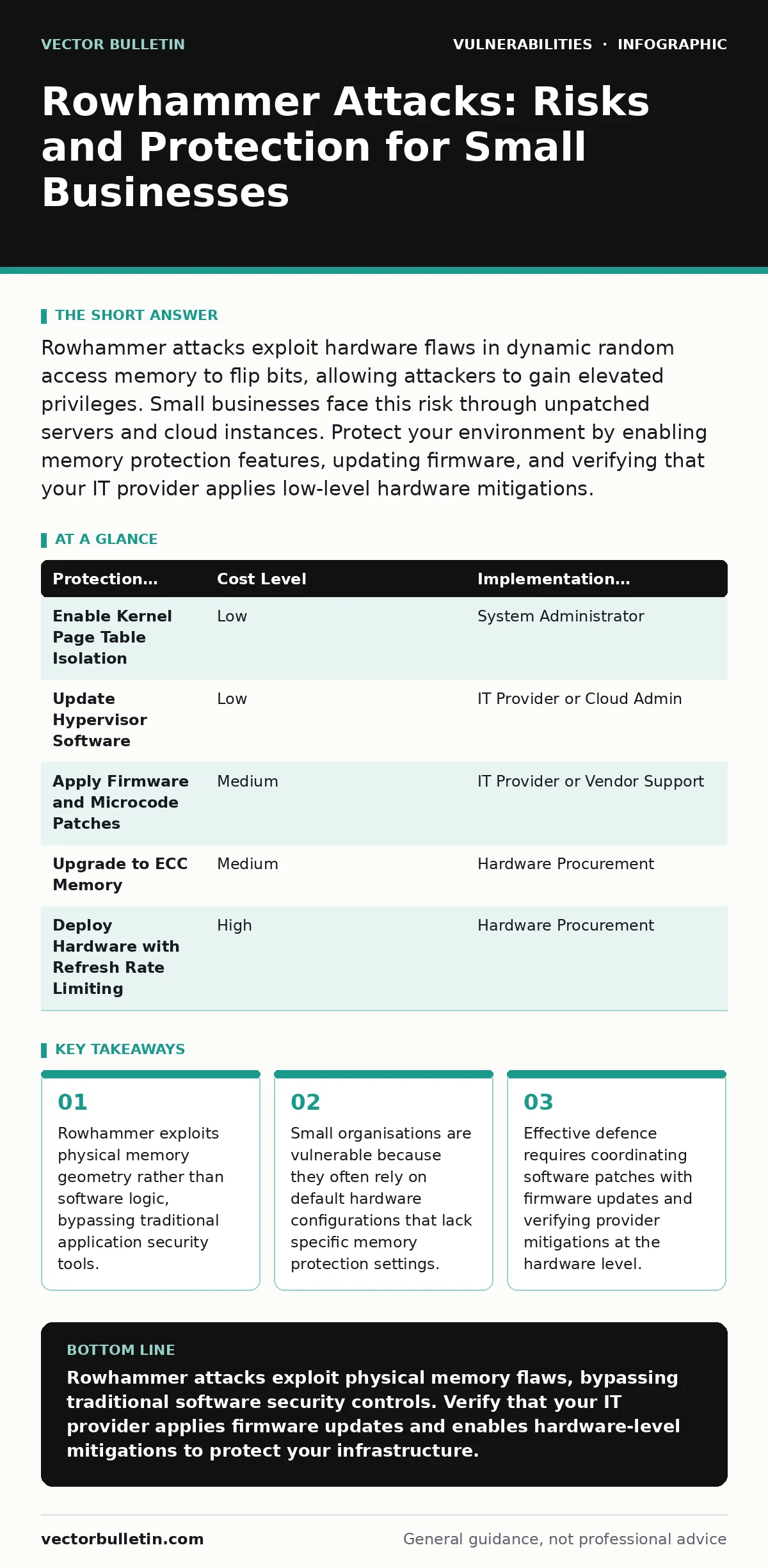
Rowhammer attacks exploit hardware flaws in dynamic random access memory to flip bits, allowing attackers to gain elevated privileges. Small businesses face this risk through unpatched servers and cloud instances. Protect your environment by enabling memory protection features, updating firmware, and verifying that your IT provider applies low-level hardware mitigations.
Understanding the Physical Mechanism of Rowhammer
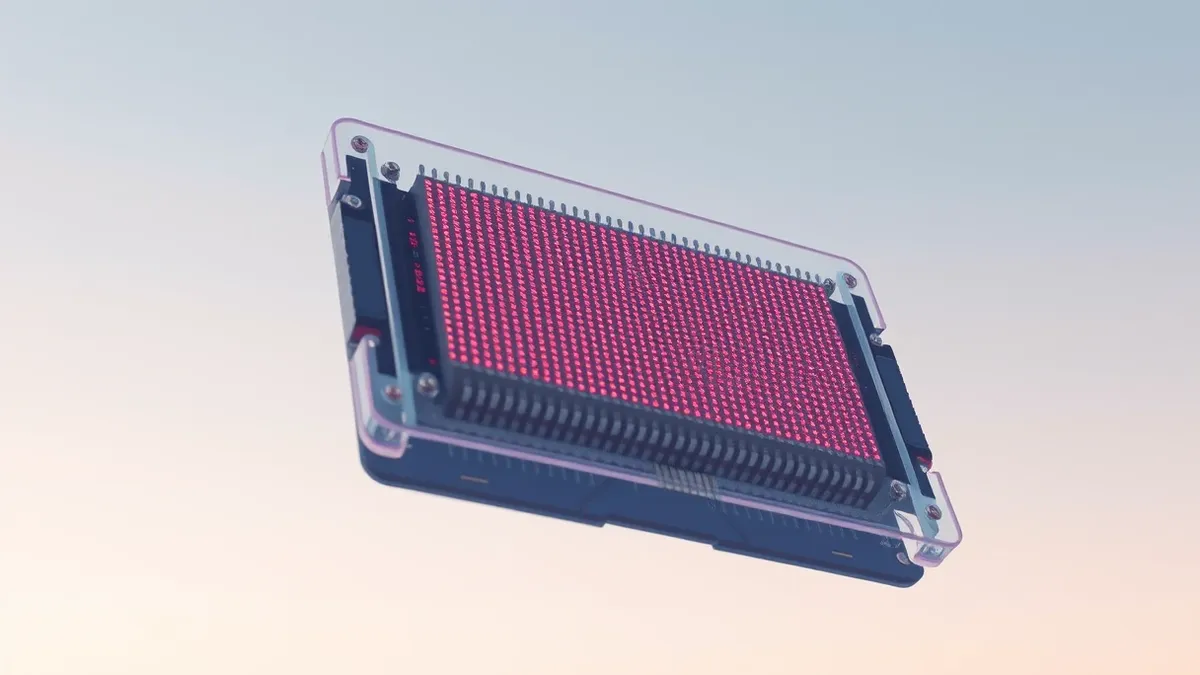
Rowhammer attacks exploit a physical characteristic of dynamic random access memory (DRAM). DRAM stores data in tiny capacitors that leak charge over time. The memory controller refreshes these capacitors periodically to retain data. When a specific row of memory is accessed repeatedly and rapidly, the electrical interference can cause adjacent rows to lose charge prematurely. This phenomenon is known as row addressing. If the adjacent row loses enough charge, a bit may flip from 0 to 1 or vice versa.
This bit flip changes the data stored in memory. If an attacker can predict which data resides in adjacent rows, they can manipulate program execution. For instance, flipping a single bit in a permission table might change a regular user account into an administrator account. Unlike traditional software vulnerabilities, this exploit targets the hardware layer. Security teams often overlook this vector because it requires specific hardware conditions and precise timing. The attack does not require a software bug in the application code itself. It relies on the physical limitations of the memory chips.
Why Small Organisations Face Disproportionate Risk
Small organisations often assume that limited visibility reduces their attack surface. This assumption fails when considering hardware-level exploits. Rowhammer attacks do not target specific business logic. They target the underlying memory architecture shared by all systems. A small company using standard cloud instances or off-the-shelf servers is just as exposed as a large enterprise if the hardware lacks mitigation.
The risk increases when small teams outsource infrastructure management. Many IT providers apply standard operating system patches but ignore firmware updates or hardware configuration changes. Firmware controls how the memory controller behaves. If the firmware is outdated, the hardware may remain vulnerable even if the operating system is secure. Small organisations rarely have dedicated staff to monitor hardware security advisories. They rely on providers to handle these low-level details. This dependency creates a blind spot. The organisation believes it is secure because its applications are patched, while the hardware remains exploitable.
The Role of Firmware and Microcode Updates
Operating system updates alone are insufficient against Rowhammer. The operating system runs above the hardware layer. It cannot prevent the physical bit flips caused by aggressive memory access. Protection requires updates to the firmware that controls the hardware. This includes BIOS updates for physical servers and hypervisor updates for virtual machines.
Microcode updates provide another layer of defence. Microcode is a set of low-level instructions that control the CPU. Manufacturers release microcode patches to mitigate Rowhammer by limiting how fast memory rows can be accessed. These patches introduce a slight performance penalty but prevent the rapid access patterns required for the attack. Small businesses often neglect firmware updates because they are perceived as risky or complex. However, the risk of leaving hardware vulnerable outweighs the minor inconvenience of updating firmware. You must ensure that your IT provider includes firmware management in their maintenance routine.
Low-Cost Protections for Limited Budgets
Implementing protection against Rowhammer does not require expensive hardware replacements in most cases. Several low-cost measures can significantly reduce risk. The first step is to enable kernel page table isolation (KPTI). This feature separates the kernel’s memory from user-space memory. It prevents an attacker from flipping bits in kernel structures to gain privileges. KPTI is available in most modern Linux kernels and Windows versions. Enabling it involves a simple configuration change.
Another low-cost measure is to update to recent versions of hypervisors. If you use virtual machines, the hypervisor controls memory allocation. Modern hypervisors include mitigations that randomise memory placement or limit access rates. Updating the hypervisor software is often free and provided by the vendor. You should also consider using memory error correction code (ECC) memory. ECC memory detects and corrects single-bit errors. While it does not prevent the bit flip, it can correct the error before it causes harm. ECC memory is standard in many server-class systems and adds minimal cost.
| Protection Measure | Cost Level | Implementation Responsibility |
|---|---|---|
| Enable Kernel Page Table Isolation | Low | System Administrator |
| Update Hypervisor Software | Low | IT Provider or Cloud Admin |
| Apply Firmware and Microcode Patches | Medium | IT Provider or Vendor Support |
| Upgrade to ECC Memory | Medium | Hardware Procurement |
| Deploy Hardware with Refresh Rate Limiting | High | Hardware Procurement |
What to Ask Your IT Provider
Your IT provider plays a critical role in hardware security. You must verify that they understand Rowhammer and apply appropriate mitigations. Do not accept vague assurances about "keeping systems updated." Ask specific questions about hardware-level security. Request details on their firmware update policy. Ask how often they check for and apply BIOS and microcode updates. Inquire about their process for testing these updates before deployment.
You should also ask about memory configuration. Does the provider enable row hammer mitigation features in the BIOS? Do they use virtual machines with memory isolation features? Request a report on the hardware models in use and their known vulnerabilities. If the provider cannot answer these questions, they may not be adequately protecting your infrastructure. This is particularly important for cloud-based services. You need to know that the underlying physical servers are secure, even if you only manage the virtual instances.
Integrating with Broader Security Strategies
Rowhammer protection must be part of your overall security strategy. It complements other security measures but does not replace them. For example, a secure code review identifies logic errors in application code but cannot fix hardware flaws. Similarly, runtime application self-protection (RASP) monitors application behaviour but cannot detect bit flips in memory. You need a layered approach.
Consider how Rowhammer interacts with other vulnerabilities. An attacker might use a heap overflow vulnerability to gain initial access and then use Rowhammer to escalate privileges. Or they might exploit sandbox escape vulnerabilities to run malicious code that triggers the hardware exploit. Understanding these connections helps you prioritise fixes. You should also review security advisories for hardware components. Manufacturers release alerts when new Rowhammer variants are discovered. Staying informed ensures you can respond quickly to new threats.
Mitigating Risk in Cloud Environments
Cloud computing introduces unique challenges for Rowhammer mitigation. You do not control the physical hardware in a cloud environment. The cloud provider manages the servers and firmware. This creates a shared responsibility model. You are responsible for securing your virtual machines and applications. The provider is responsible for securing the physical infrastructure.
You must verify that your cloud provider implements hardware mitigations. Ask for their security documentation. Look for details on how they handle firmware updates and memory configuration. Some providers offer specific security features that mitigate Rowhammer. Others may not. If your provider does not offer adequate protection, you may need to switch providers. Alternatively, you can use encryption to protect sensitive data. Encryption ensures that even if an attacker flips bits, the data remains unreadable. This does not prevent the attack but reduces its impact.
Long-Term Hardware Considerations
As memory technology evolves, new mitigation techniques emerge. Some modern memory chips include hardware features that limit row access rates. These features provide stronger protection than software patches. When purchasing new hardware, look for these features. Specify them in your procurement requirements. This ensures that your future infrastructure is resistant to Rowhammer attacks.
You should also plan for hardware refresh cycles. Older hardware may not support the latest mitigations. If your servers are several years old, they may be inherently vulnerable. Upgrading to newer hardware can eliminate the risk entirely. This is a long-term investment that reduces security complexity. It simplifies your security posture by removing the need for software workarounds. Regularly assess your hardware age and capabilities to ensure ongoing protection.
Key takeaways
- Rowhammer exploits physical memory geometry rather than software logic, bypassing traditional application security tools.
- Small organisations are vulnerable because they often rely on default hardware configurations that lack specific memory protection settings.
- Effective defence requires coordinating software patches with firmware updates and verifying provider mitigations at the hardware level.
Rowhammer attacks exploit physical memory flaws, bypassing traditional software security controls. Verify that your IT provider applies firmware updates and enables hardware-level mitigations to protect your infrastructure.
Frequently asked questions
Can Rowhammer attacks occur on personal computers?
Yes, Rowhammer attacks can occur on any system using dynamic random access memory. Personal computers are vulnerable if the hardware lacks mitigation features or if firmware is outdated.
How do I know if my server is vulnerable to Rowhammer?
You can test for vulnerability using specific diagnostic tools that simulate the attack pattern. These tools check if bit flips can be induced. Consult your hardware manufacturer for recommended testing procedures.
Does encryption prevent Rowhammer attacks?
Encryption does not prevent the bit flips caused by Rowhammer. However, it protects the data itself. If an attacker flips bits in encrypted data, the resulting corruption is detectable and the data remains unreadable.
Is Rowhammer a risk for cloud-based applications?
Yes, cloud-based applications are at risk if the underlying physical servers are vulnerable. The cloud provider is responsible for hardware mitigations. You must verify that your provider implements these protections.
How this guide was produced: written by the Vector Bulletin editorial team with AI assistance, checked against the public references listed below, and reviewed when the facts change. See our editorial policy or report an error.