
EDR vs XDR: How to Choose the Right Detection Architecture
XDR does not replace endpoint agents; it aggregates signals across platforms, creating a higher noise floor that requires mature triage processes to manage effectively.
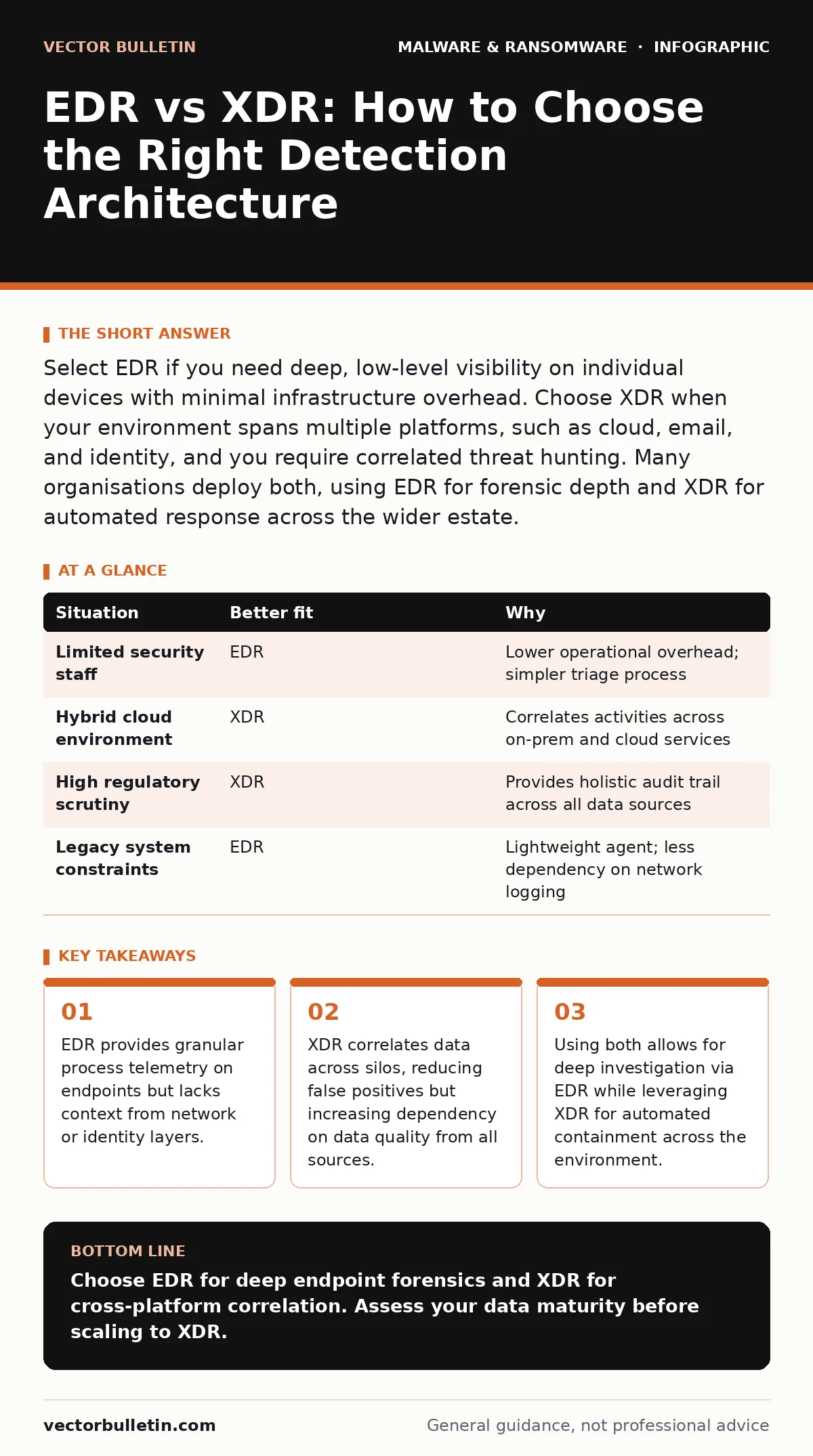
Select EDR if you need deep, low-level visibility on individual devices with minimal infrastructure overhead. Choose XDR when your environment spans multiple platforms, such as cloud, email, and identity, and you require correlated threat hunting. Many organisations deploy both, using EDR for forensic depth and XDR for automated response across the wider estate.
The Granularity of Endpoint Visibility
Endpoint Detection and Response (EDR) tools record detailed activity on individual devices. They capture process creation, file modifications, and registry changes. This depth allows analysts to reconstruct exactly what happened during an incident. The agent runs locally, ensuring data collection continues even if network connectivity drops.
However, this focus comes with a cost. EDR tools generate significant noise because they record every minor change. Analysts must sift through benign administrative tasks to find malicious behaviour. The tool tells you what the endpoint did, but not why it did it in the context of the wider network. It is a microscope, not a telescope.
The Scope of Cross-Platform Correlation
Extended Detection and Response (XDR) aggregates data from multiple sources. It combines logs from endpoints, network appliances, email gateways, and cloud platforms. The primary value is correlation. A suspicious login in the identity layer gains meaning when paired with unusual file access on a workstation.
This approach reduces alert fatigue by grouping related events into single incidents. Instead of ten separate alerts, you see one narrative. However, XDR relies on the quality of data from each source. If your email scanner fails to log header details, the correlation engine cannot function. It is only as strong as its weakest data feed.
Consider identity sprawl when evaluating XDR capabilities. If your user accounts are spread across multiple directories, the XDR must normalise these identities to track lateral movement. Without this, the tool creates gaps in the attack chain.
The Operational Maturity Requirement
Implementing XDR demands a higher level of operational maturity. You must define data retention policies for every integrated platform. You need clear procedures for investigating correlated alerts that span different technologies. If your team struggles to triage basic endpoint alerts, XDR will overwhelm them.
EDR is more forgiving in this regard. The data is uniform because it comes from a single agent type. Training focuses on one interface and one set of forensic techniques. You can start investigating immediately after deployment. XDR requires you to understand how network flows relate to process trees.
The trade-off is clear. EDR offers simplicity and depth at the edge. XDR offers breadth and context but requires complex governance. Your choice depends on your team’s ability to manage data complexity.
Situations That Favour Each Approach
Different environments favour different architectures. A small office with identical workstations benefits from EDR. The uniformity makes baseline creation easy. An organisation with hybrid cloud workloads needs XDR. The attack surface is too distributed for endpoint-only visibility.
| Situation | Better fit | Why |
|---|---|---|
| Limited security staff | EDR | Lower operational overhead; simpler triage process |
| Hybrid cloud environment | XDR | Correlates activities across on-prem and cloud services |
| High regulatory scrutiny | XDR | Provides holistic audit trail across all data sources |
| Legacy system constraints | EDR | Lightweight agent; less dependency on network logging |
When resources are tight, EDR is often the pragmatic choice. It provides immediate value without requiring integration work. When threats are sophisticated and multi-stage, XDR is necessary. It reveals patterns that single-source tools miss.
Integrating Both for Defence in Depth
Many organisations use both EDR and XDR. This is not redundant; it is complementary. The EDR agent continues to collect deep forensic data. The XDR platform ingests that data along with network and identity logs. The analyst uses the XDR console for the high-level view. They drill down into the EDR interface for detailed investigation.
This setup mitigates the weaknesses of each. The EDR handles the local execution details. The XDR handles the lateral movement and initial access vectors. You get the best of both worlds: depth and breadth.
Ensure the two tools talk to each other. If the XDR detects a compromised account, it should trigger the EDR to isolate the affected devices. Automation bridges the gap between detection and response. Without integration, you have two separate tools doing similar jobs.
See also: Immutable Backups: Answers to 9 Operational Questions · Email Attachment Scanning Checklist for Secure Gateways
The Hidden Cost of Data Volume
Both tools generate massive amounts of data. EDR logs every process launch. XDR ingests logs from dozens of sources. Storage costs rise quickly. You must plan for data retention. Keeping six months of full telemetry is expensive. Keeping six months of aggregated alerts is cheaper but less useful for forensics.
You must also consider the skill gap. XDR requires analysts who understand network protocols, identity management, and endpoint internals. EDR requires expertise in operating system internals. Hiring for XDR is harder. The role is broader.
Review your malware analysis procedures. If you rely on EDR for sample extraction, ensure the XDR does not strip necessary metadata during ingestion. Loss of context at any stage hampers investigation.
Final Selection Criteria
Ask yourself three questions. First, how distributed is your environment? If you are mostly on-premises, EDR may suffice. If you are in the cloud, XDR is preferable. Second, what is your team’s expertise? If they are endpoint specialists, start with EDR. If they are generalists, XDR may suit them better. Third, what is your budget for data storage? XDR is typically more expensive to run.
There is no universal winner. The right tool depends on your specific constraints. Start with the problem you need to solve. If you need to stop ransomware on laptops, EDR is effective. If you need to stop remote access trojans moving laterally, XDR is superior.
Key takeaways
- EDR provides granular process telemetry on endpoints but lacks context from network or identity layers.
- XDR correlates data across silos, reducing false positives but increasing dependency on data quality from all sources.
- Using both allows for deep investigation via EDR while leveraging XDR for automated containment across the environment.
Choose EDR for deep endpoint forensics and XDR for cross-platform correlation. Assess your data maturity before scaling to XDR.
Frequently asked questions
Can XDR replace EDR entirely?
No. XDR platforms often use EDR agents to collect endpoint data. Removing the agent eliminates the deep process-level visibility that XDR relies on for correlation.
Does XDR protect against zero-day malware?
No tool guarantees protection against unknown threats. XDR improves detection odds by correlating behaviour across platforms, but it still relies on behavioural heuristics and indicators.
How long does it take to deploy XDR?
Deployment varies by environment complexity. Integrating email, identity, and network logs can take months. EDR deployment is faster as it involves installing a single agent type.
Is EDR enough for a cloud-only organisation?
EDR can protect cloud instances, but it misses network-level threats. XDR is generally preferred for cloud environments to correlate cloud-native logs with workload activity.
How this guide was produced: written by the Vector Bulletin editorial team with AI assistance, checked against the public references listed below, and reviewed when the facts change. See our editorial policy or report an error.