
Static Malware Analysis: 6 Myths That Compromise Your Results
Static analysis reveals structure and intent without execution, but relying on it alone leaves hidden payload delivery mechanisms entirely undetected by your security tools.
Static malware analysis examines code without running it. It identifies known patterns and structural anomalies but misses runtime behaviour. Misunderstanding its limits leads to false confidence. You must combine static findings with dynamic observation to detect obfuscation, multi-stage payloads and environment-dependent logic that only triggers during execution.
Misreading: Static analysis guarantees detection of all malicious code
Correct reading: Static analysis examines the binary structure, headers and embedded strings of a file without executing it. It identifies known indicators of compromise, such as suspicious imports or hardcoded IP addresses. It does not guarantee detection of novel or heavily obfuscated malware. A file can pass static checks while containing logic that only activates when specific conditions are met. You must treat static results as an initial filter, not a final verdict.
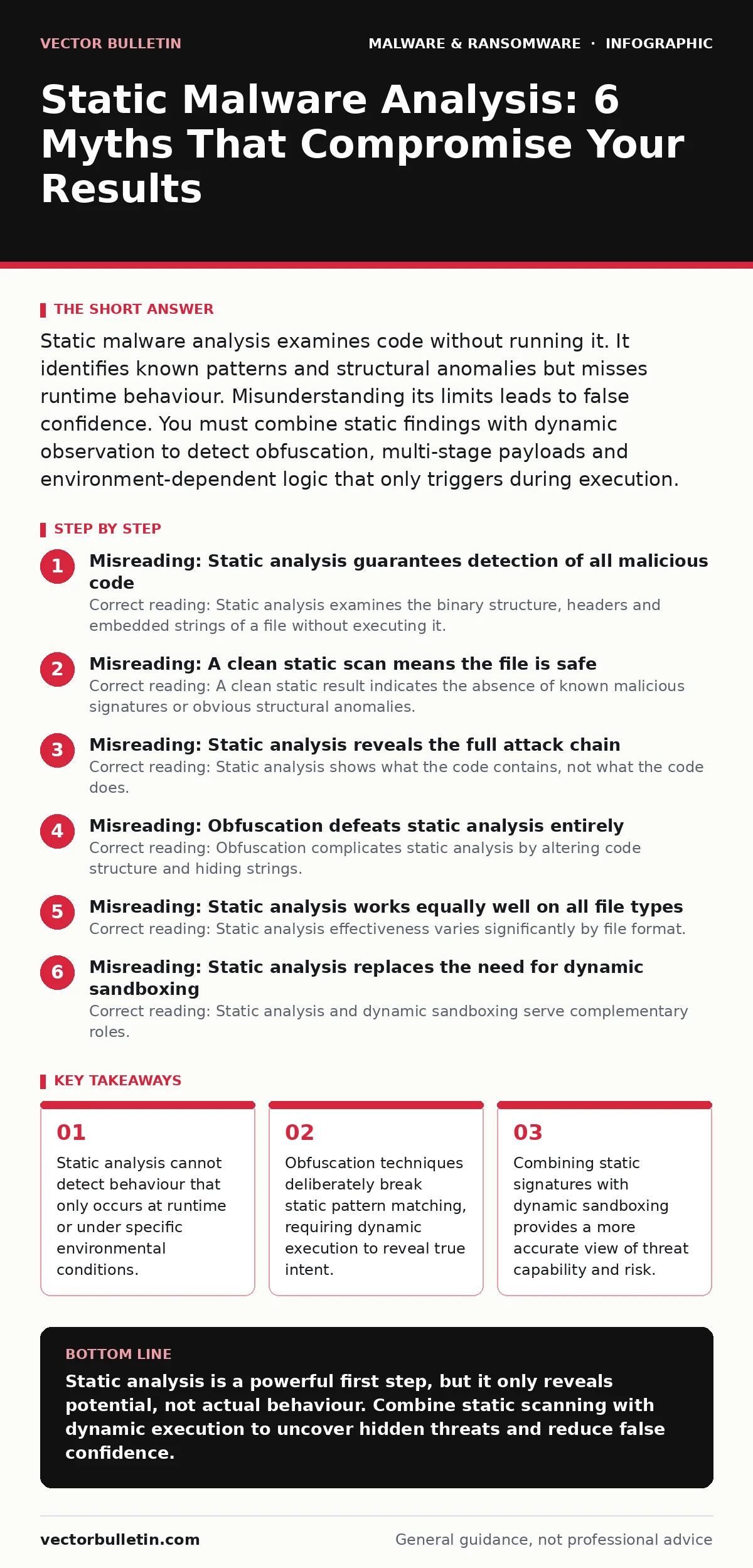
Misreading: A clean static scan means the file is safe
Correct reading: A clean static result indicates the absence of known malicious signatures or obvious structural anomalies. It does not prove the file is benign. Attackers often use packing or encryption to hide malicious payloads from static inspection. The file may appear harmless until it executes and unpacks its true contents in memory. Relying solely on static scans leaves you vulnerable to zero-day threats and custom malware that lacks established signatures. Always validate suspicious files through dynamic analysis.
Misreading: Static analysis reveals the full attack chain
Correct reading: Static analysis shows what the code contains, not what the code does. It identifies potential capabilities, such as network access or file manipulation functions. It cannot confirm which capabilities are actually used during an attack. Many malware samples include dormant code that never executes. You cannot determine the sequence of actions, the timing of events or the interaction with other system components through static review alone. Dynamic analysis is required to map the actual attack chain and observe runtime behaviour.
Misreading: Obfuscation defeats static analysis entirely
Correct reading: Obfuscation complicates static analysis by altering code structure and hiding strings. It does not make static analysis useless. Advanced static tools can deobfuscate certain techniques, such as simple string encryption or control flow flattening. However, heavy obfuscation increases the effort required to extract meaningful indicators. You may miss subtle indicators if you rely on basic signature matching. Combining static deobfuscation with dynamic execution helps reveal the underlying logic. Do not assume obfuscated code is undetectable, but expect higher analysis costs.
Misreading: Static analysis works equally well on all file types
Correct reading: Static analysis effectiveness varies significantly by file format. Executable binaries provide rich structural data for analysis. Scripts and interpreted languages offer less structure and more reliance on runtime interpretation. Document files with macros require different handling than compiled programs. Archive files must be unpacked and inspected recursively. Each format presents unique challenges and requires specific parsing logic. Using a generic static analyzer on diverse file types leads to missed detections. Tailor your analysis approach to the specific file format and expected content.
See also: Email Attachment Scanning Checklist for Secure Gateways · Remote Access Trojan Myths: What Operators Actually Know
Misreading: Static analysis replaces the need for dynamic sandboxing
Correct reading: Static analysis and dynamic sandboxing serve complementary roles. Static analysis provides speed and scale, processing thousands of files quickly. Dynamic sandboxing provides depth, observing actual behaviour in a controlled environment. Static analysis misses runtime polymorphism and environment-dependent logic. Dynamic analysis captures these behaviours but consumes more resources. Relying on static analysis alone creates blind spots. Using both methods together provides a more complete picture of threat risk. Integrate static scanning as a first line of defence, followed by dynamic analysis for suspicious items.
Misreading: Static analysis indicators are always actionable
Correct reading: Static analysis generates many indicators, such as strings, imports and hashes. Not all indicators are useful for detection or response. Some indicators are common in legitimate software, leading to false positives. Others are specific to a single sample, offering no broader protection. You must validate indicators against known benign data and threat intelligence feeds. Prioritise indicators that reveal capability or intent, such as network endpoints or command-and-control infrastructure. Discard noisy indicators that clutter your security operations and reduce analyst efficiency.
Misreading: Static analysis is sufficient for mobile threats
Correct reading: Mobile malware presents unique challenges for static analysis. Android applications package code, resources and metadata in a single archive. Static analysis can inspect manifest files and permission requests. It cannot fully assess runtime behaviour, such as dynamic code loading or reflection. iOS binaries are often stripped of symbols, making static analysis difficult. Mobile operating systems enforce strict sandboxing, limiting the impact of many threats. However, sophisticated mobile malware bypasses these controls. Combine static analysis of mobile packages with dynamic testing on emulated devices to ensure comprehensive coverage.
Misreading: Static analysis tools are plug-and-play solutions
Correct reading: Static analysis tools require configuration and tuning to be effective. Default settings may miss subtle indicators or generate excessive noise. You must adjust sensitivity thresholds, update signature databases and customise parsing rules for your environment. Integrating static analysis into your security workflow requires careful planning. Ensure results are correlated with other data sources, such as endpoint detection and network logs. Regularly review and refine your static analysis strategy to address evolving threats. Treat static analysis as a skill, not just a tool.
Misreading: Static analysis ignores the human element
Correct reading: Static analysis produces data, not conclusions. Analysts must interpret results, correlate findings and make decisions. Automated tools can miss nuanced indicators or misclassify complex code. Human expertise is required to distinguish between malicious and legitimate code patterns. Training analysts in reverse engineering and code analysis improves the value of static results. Encourage collaboration between static and dynamic analysis teams. Share insights and refine detection rules based on real-world observations. Static analysis is a support tool for human analysts, not a replacement.
Key takeaways
- Static analysis cannot detect behaviour that only occurs at runtime or under specific environmental conditions.
- Obfuscation techniques deliberately break static pattern matching, requiring dynamic execution to reveal true intent.
- Combining static signatures with dynamic sandboxing provides a more accurate view of threat capability and risk.
Static analysis is a powerful first step, but it only reveals potential, not actual behaviour. Combine static scanning with dynamic execution to uncover hidden threats and reduce false confidence.
Frequently asked questions
How do I choose between static and dynamic analysis for a new file?
Start with static analysis for speed and scale. If the file is suspicious or obfuscated, proceed to dynamic analysis in a sandbox to observe actual behaviour and confirm intent.
Can static analysis detect fileless malware?
Static analysis cannot detect fileless malware directly, as there is no file to inspect. It may detect the initial dropper or script that delivers the fileless payload. Dynamic analysis is required to observe the runtime execution.
What are the limitations of static analysis for ransomware?
Static analysis may identify encryption libraries or ransom notes embedded in the code. It cannot confirm encryption behaviour or key management logic. Dynamic analysis is needed to observe the encryption process and victim impact.
How often should I update my static analysis signatures?
Update signatures frequently to keep pace with evolving threats. Integrate with threat intelligence feeds to receive new indicators automatically. Regular updates ensure your static tools remain effective against current malware variants.
How this guide was produced: written by the Vector Bulletin editorial team with AI assistance, checked against the public references listed below, and reviewed when the facts change. See our editorial policy or report an error.