
BGP Hijacking: How Route Manipulation Works and How to Detect It
Border Gateway Protocol relies on trust between networks, meaning a single misconfiguration can silently divert traffic without triggering traditional security alerts.
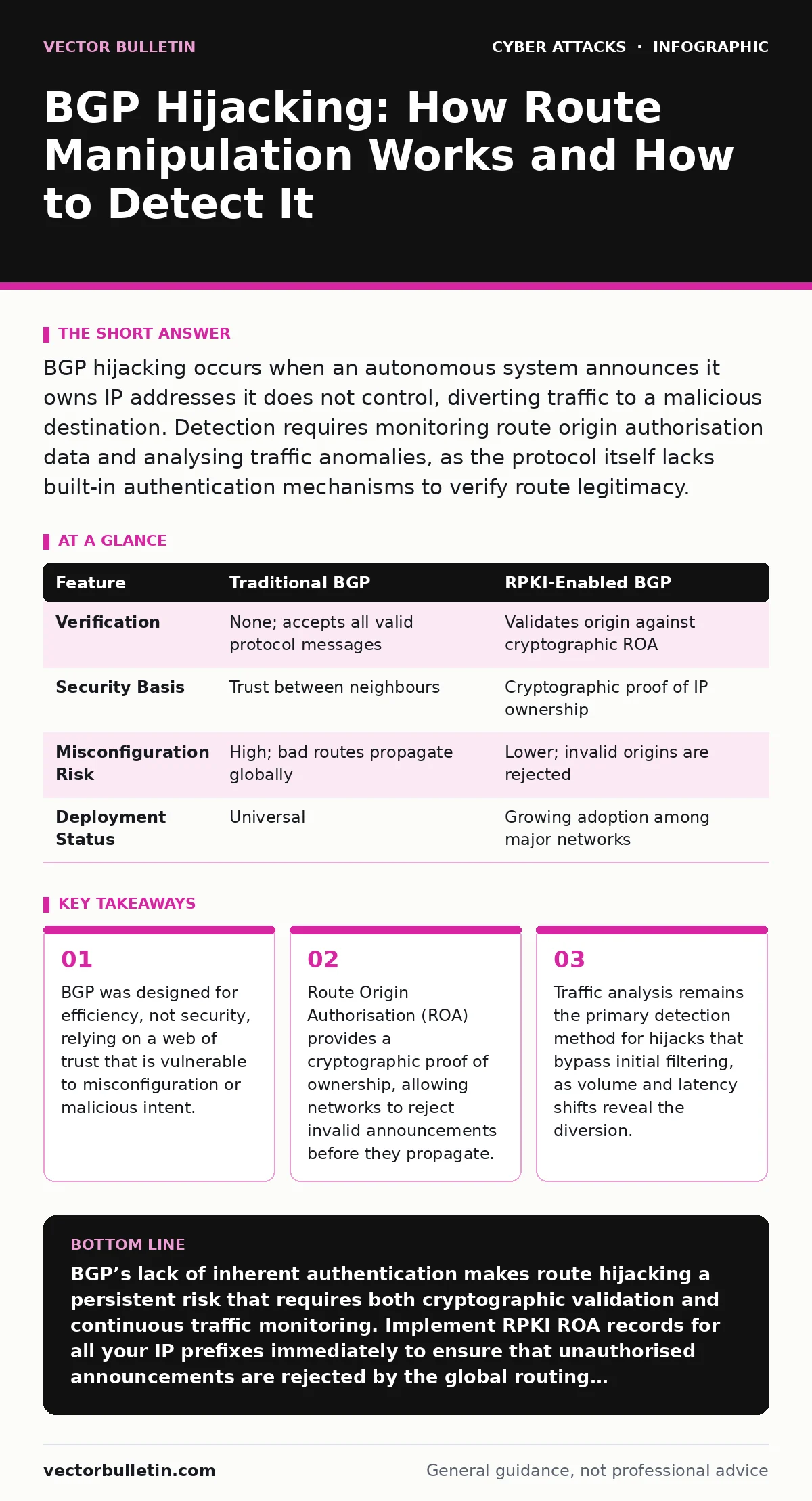
BGP hijacking occurs when an autonomous system announces it owns IP addresses it does not control, diverting traffic to a malicious destination. Detection requires monitoring route origin authorisation data and analysing traffic anomalies, as the protocol itself lacks built-in authentication mechanisms to verify route legitimacy.
What exactly is a BGP hijack?
A Border Gateway Protocol (BGP) hijack is the act of announcing ownership of IP address blocks that belong to another organisation. BGP is the protocol that exchanges routing information between autonomous systems on the internet, determining the path data takes to reach its destination. When an entity announces a route for IP addresses they do not control, other networks may redirect traffic to them. This diversion allows the attacker to intercept, modify, or drop the data in transit.
Why does the internet allow this to happen?
The internet’s routing infrastructure was built on a model of mutual trust rather than cryptographic verification. Autonomous systems announce the routes they can reach, and neighbouring systems accept these announcements if they appear valid within the protocol’s rules. There is no central authority that validates whether an entity actually owns the IP space it claims to serve. This design choice prioritises scalability and flexibility, allowing new networks to join the global mesh without complex bureaucratic hurdles. The trade-off is that the protocol cannot distinguish between a legitimate announcement and a fraudulent one.
How can you detect a hijack in progress?
Detection typically relies on monitoring tools that compare announced routes against expected baselines. You should implement systems that alert when new, unexpected prefixes appear in the global routing table for your address space. Traffic analysis provides a secondary layer of detection by identifying sudden drops in inbound volume or unusual latency spikes. If your servers stop receiving expected connections, the traffic may be flowing elsewhere. Combining route monitoring with flow analysis increases the likelihood of catching a hijack before significant data loss occurs.
What is RPKI and how does it help?
Resource Public Key Infrastructure (RPKI) adds a layer of security by allowing IP address holders to create Route Origin Authorisation (ROA) objects. A ROA is a signed statement that specifies which autonomous systems are authorised to announce specific IP prefixes. Networks that validate RPKI can reject announcements that do not match the authorised ROA records. This prevents attackers from successfully hijacking routes if the victim has configured their authorisation correctly. It shifts the model from pure trust to verified ownership, reducing the attack surface significantly.
| Feature | Traditional BGP | RPKI-Enabled BGP |
|---|---|---|
| Verification | None; accepts all valid protocol messages | Validates origin against cryptographic ROA |
| Security Basis | Trust between neighbours | Cryptographic proof of IP ownership |
| Misconfiguration Risk | High; bad routes propagate globally | Lower; invalid origins are rejected |
| Deployment Status | Universal | Growing adoption among major networks |
Can a hijack be accidental rather than malicious?
Misconfigurations are a frequent cause of unintended route hijacks. An administrator might accidentally announce a more specific prefix, causing traffic to leak into their network unintentionally. This is known as a route leak, and it can disrupt services just as effectively as a deliberate attack. Suppose an engineer forgets to filter outbound routes during a maintenance window. The global routing table may update to send traffic for a major cloud provider through that engineer’s small network. The result is often a sudden, unexplained surge in traffic that overwhelms the misconfigured link.
See also: Firewall Rules: Concrete Benefits and Hidden Limitations · Smart Home Security Mistakes That Invite Intrusion and How to Fix Them
How do attackers use hijacking for data theft?
Attackers often use hijacking to position themselves as a man-in-the-middle between users and a target service. By diverting traffic, they can decrypt HTTPS connections if they can perform a SSL stripping attack or install a malicious certificate. This allows them to harvest credentials or inject malware into the data stream. The technique is particularly effective against systems that lack strict certificate pinning. Without pinning, a user’s browser may accept a fraudulent certificate presented by the hijacker, believing it is legitimate. This vulnerability underscores why secure code review practices are necessary for applications handling sensitive data.
What happens if your IP space is hijacked?
Immediate disruption of services is the most common consequence. Users attempting to reach your website or application will experience timeouts or be redirected to a blank page. If the attacker mirrors your content, the disruption may be subtle, with only security teams noticing the anomaly. Search engine rankings can suffer if the hijacked site serves degraded or malicious content. Reversing a hijack requires contacting upstream providers to filter the malicious announcements, a process that can take hours. During this window, your organisation loses control over its digital presence.
Why is BGP security so difficult to implement globally?
The decentralised nature of the internet means there is no single switch to flip for global security. Every network operator must individually decide to implement and enforce RPKI validation. Some operators fear that validating routes might inadvertently block legitimate traffic if ROA records are incorrect. This caution leads to inconsistent adoption, leaving gaps that attackers can exploit. Furthermore, the protocol’s statefulness means that even if you secure your own announcements, you remain vulnerable to hijacks of your dependencies. This complexity mirrors the challenges seen in supply chain attacks, where one weak link compromises the entire system.
Does encryption protect against BGP hijacking?
Encryption protects the content of your data but does not prevent the traffic from being diverted. If an attacker hijacks the route, they can still drop the packets, causing a denial of service. They can also attempt to break the encryption or exploit client-side vulnerabilities to steal data. Encryption ensures that even if traffic is intercepted, the payload remains unreadable without the keys. However, it does not guarantee availability or integrity of the delivery path. For systems handling high-value credentials, consider how privileged access management strategies can limit the damage if credentials are somehow exposed during a diversion.
How do you recover from a successful hijack?
Recovery begins with identifying the malicious autonomous system number responsible for the hijack. You must then contact your upstream internet service providers and request they filter out the offending announcements. This process relies on cooperation from other network operators, which can slow down the resolution. Implementing RPKI ROA records for all your prefixes is the most effective long-term prevention. This ensures that even if an attacker announces your space, validating networks will reject the route. Regular audits of your routing policies help prevent accidental leaks that weaken your security posture.
What is the role of traffic analysis in detection?
Traffic analysis tools monitor the volume and patterns of data flowing in and out of your network. A sudden drop in inbound traffic, even if outbound traffic remains normal, is a strong indicator of a hijack. You should establish baseline metrics for normal traffic patterns to identify deviations quickly. Machine learning models can help distinguish between natural fluctuations and malicious diversions. This method complements RPKI by detecting hijacks that might bypass initial filters or occur in regions with low RPKI adoption. It is similar to how teams monitor for Slowloris attacks, where the anomaly is in the behaviour pattern rather than the payload.
Key takeaways
- BGP was designed for efficiency, not security, relying on a web of trust that is vulnerable to misconfiguration or malicious intent.
- Route Origin Authorisation (ROA) provides a cryptographic proof of ownership, allowing networks to reject invalid announcements before they propagate.
- Traffic analysis remains the primary detection method for hijacks that bypass initial filtering, as volume and latency shifts reveal the diversion.
BGP’s lack of inherent authentication makes route hijacking a persistent risk that requires both cryptographic validation and continuous traffic monitoring. Implement RPKI ROA records for all your IP prefixes immediately to ensure that unauthorised announcements are rejected by the global routing infrastructure.
Frequently asked questions
Can a small organisation protect itself from BGP hijacking?
Yes, by implementing RPKI ROA records for all allocated IP space and monitoring inbound and outbound traffic for anomalies. Even small networks benefit from the global filtering that RPKI enables.
Does using a Content Delivery Network (CDN) prevent hijacking?
A CDN can mitigate the impact by providing alternative paths for traffic, but it does not prevent the underlying routing issue. If the origin IP is hijacked, the CDN may still be affected depending on the configuration.
How long does it take for a hijack to propagate globally?
Propagation can occur within minutes, as BGP updates spread rapidly across autonomous systems. The speed depends on the number of networks that accept and re-announce the malicious route.
Is RPKI mandatory for internet service providers?
No, RPKI adoption is voluntary for each network operator. However, major providers and registries increasingly encourage or require validation to maintain the integrity of the global routing table.
How this guide was produced: written by the Vector Bulletin editorial team with AI assistance, checked against the public references listed below, and reviewed when the facts change. See our editorial policy or report an error.