IPv6 security vs IPv4: structural design changes that alter risk
Network protocol architecture determines how packets reach endpoints, shifting the burden from address translation to cryptographic validation.
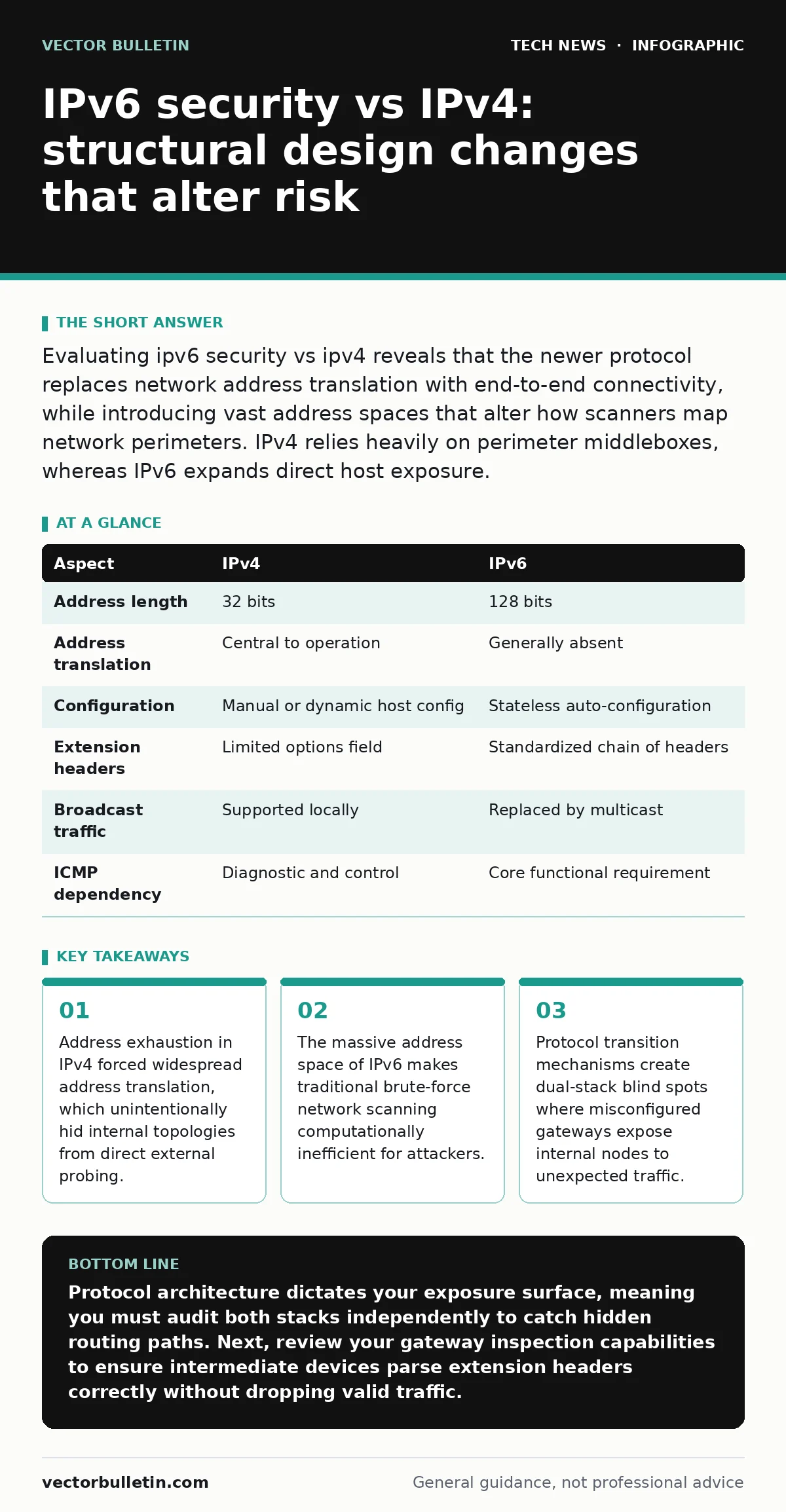
Evaluating ipv6 security vs ipv4 reveals that the newer protocol replaces network address translation with end-to-end connectivity, while introducing vast address spaces that alter how scanners map network perimeters. IPv4 relies heavily on perimeter middleboxes, whereas IPv6 expands direct host exposure.
Fundamental Protocol Differences
Understanding ipv6 security vs ipv4 requires looking at how addressing architecture shapes network boundary defense. IPv4 uses 32-bit addresses, creating a scarcity that popularized network address translation, a technique where a gateway hides multiple internal devices behind a single public identifier. IPv6 expands to 128-bit addresses, assigning globally unique identifiers directly to individual endpoints. This design shift removes the inherent topological obscurity provided by address translation, placing the burden of access control entirely on host firewalls and stateful inspection engines.
Architectural Comparison of Network Protocols
Contrasting these two iterations highlights distinct operational trade-offs across addressing, routing, and extension headers. Network administrators managing virtualization security must account for how hypervisors handle these underlying packet structures differently across protocol boundaries.
| Aspect | IPv4 | IPv6 |
|---|---|---|
| Address length | 32 bits | 128 bits |
| Address translation | Central to operation | Generally absent |
| Configuration | Manual or dynamic host config | Stateless auto-configuration |
| Extension headers | Limited options field | Standardized chain of headers |
| Broadcast traffic | Supported locally | Replaced by multicast |
| ICMP dependency | Diagnostic and control | Core functional requirement |
Address Space Expansion and Scanning Mechanics
A common assumption suggests that larger address pools automatically prevent reconnaissance. Attackers rarely scan entire subnets sequentially; instead, they target predictable address patterns, predictable interface identifiers derived from hardware addresses, or services leaked through application logs. The vast address space slows down random scanning, but targeted discovery techniques remain effective against poorly configured hosts. Managing firewall rules becomes more complex when every node possesses multiple globally reachable addresses spanning different scopes.
Extension Headers and Inspection Challenges
The core design of the newer protocol incorporates extension headers placed between the base header and the upper-layer payload. These chained headers allow packets to carry optional routing, fragmentation, or security information efficiently. Security appliances must parse every chained header to inspect the actual payload, creating computational bottlenecks that can lead to device crashes or packet dropping under heavy load. Attackers exploit this processing overhead by crafting convoluted header chains that bypass middlebox inspection entirely.
Neighbor Discovery and Local Network Risk
Local network communication relies on neighbor discovery protocols rather than legacy address resolution methods. Nodes use multicast messaging to locate routers and map local hardware addresses dynamically. This reliance on multicast creates vulnerabilities if attackers inject forged neighbor advertisements into the local segment, redirecting traffic through compromised machines. Without strict cryptographic validation enabled on local links, malicious actors easily perform traffic redirection on switched networks.
Transition Mechanisms and Dual-Stack Vulnerabilities
Most networks operate in a dual-stack configuration, supporting both protocols simultaneously to maintain compatibility with legacy systems. This dual architecture doubles the surface area for misconfiguration, as administrators often apply strict security policies to the legacy protocol while neglecting the newer layer. Attackers frequently exploit the unmonitored protocol channel to bypass perimeter defenses, tunnel malicious payloads, or exfiltrate data through protocols that lack adequate monitoring.
Choose the First When
- Your infrastructure relies heavily on legacy hardware appliances that lack firmware updates for newer protocol stacks.
- Network monitoring pipelines and incident response playbooks are tightly coupled with address translation logs.
- Third-party vendors mandate specific legacy configurations for compliance and interoperability testing.
- Internal applications depend on broadcast mechanisms that do not translate cleanly to multicast equivalents.
Choose the Second When
- You manage modern AI data centers requiring direct, uninhibited node-to-node communication without translation overhead.
- Your organization operates distributed remote endpoints that demand end-to-end cryptographic authentication without intermediate gateways.
- Compliance frameworks require verifiable digital signatures directly embedded at the network layer rather than relying on perimeter proxies.
- Mobile device architectures require persistent address allocation across frequent network handovers.
Key takeaways
- Address exhaustion in IPv4 forced widespread address translation, which unintentionally hid internal topologies from direct external probing.
- The massive address space of IPv6 makes traditional brute-force network scanning computationally inefficient for attackers.
- Protocol transition mechanisms create dual-stack blind spots where misconfigured gateways expose internal nodes to unexpected traffic.
Protocol architecture dictates your exposure surface, meaning you must audit both stacks independently to catch hidden routing paths. Next, review your gateway inspection capabilities to ensure intermediate devices parse extension headers correctly without dropping valid traffic.
Frequently asked questions
Does IPv6 eliminate the need for network address translation?
The protocol design removes the functional necessity for address translation by providing globally unique addresses to every endpoint. However, organizations sometimes deploy translation layers anyway for boundary control or during migration phases.
How does stateless address auto-configuration impact network visibility?
Devices generate their own addresses based on router advertisements and local interface identifiers without requiring central server logs. This autonomy makes tracking asset inventories difficult for security teams relying on traditional dynamic host allocation records.
Can firewalls inspect IPv6 traffic as effectively as IPv4 traffic?
Inspection devices can process the traffic, but arbitrary extension header chains complicate deep packet analysis and consume higher computational resources. If an appliance fails to parse chained headers correctly, malicious payloads can slip past inspection filters.
Why do dual-stack networks introduce additional risks?
Running both protocols simultaneously requires maintaining parallel security policies, increasing the likelihood of administrative oversight and configuration drift. Attackers often target the less-monitored protocol stack to bypass perimeter defenses.
How this guide was produced: written by the Vector Bulletin editorial team with AI assistance, checked against the public references listed below, and reviewed when the facts change. See our editorial policy or report an error.