
Should I enable virtualization based security and what breaks
Virtualisation-based security isolates core operating system processes in hardware-enforced memory regions, but lowers maximum raw CPU throughput.
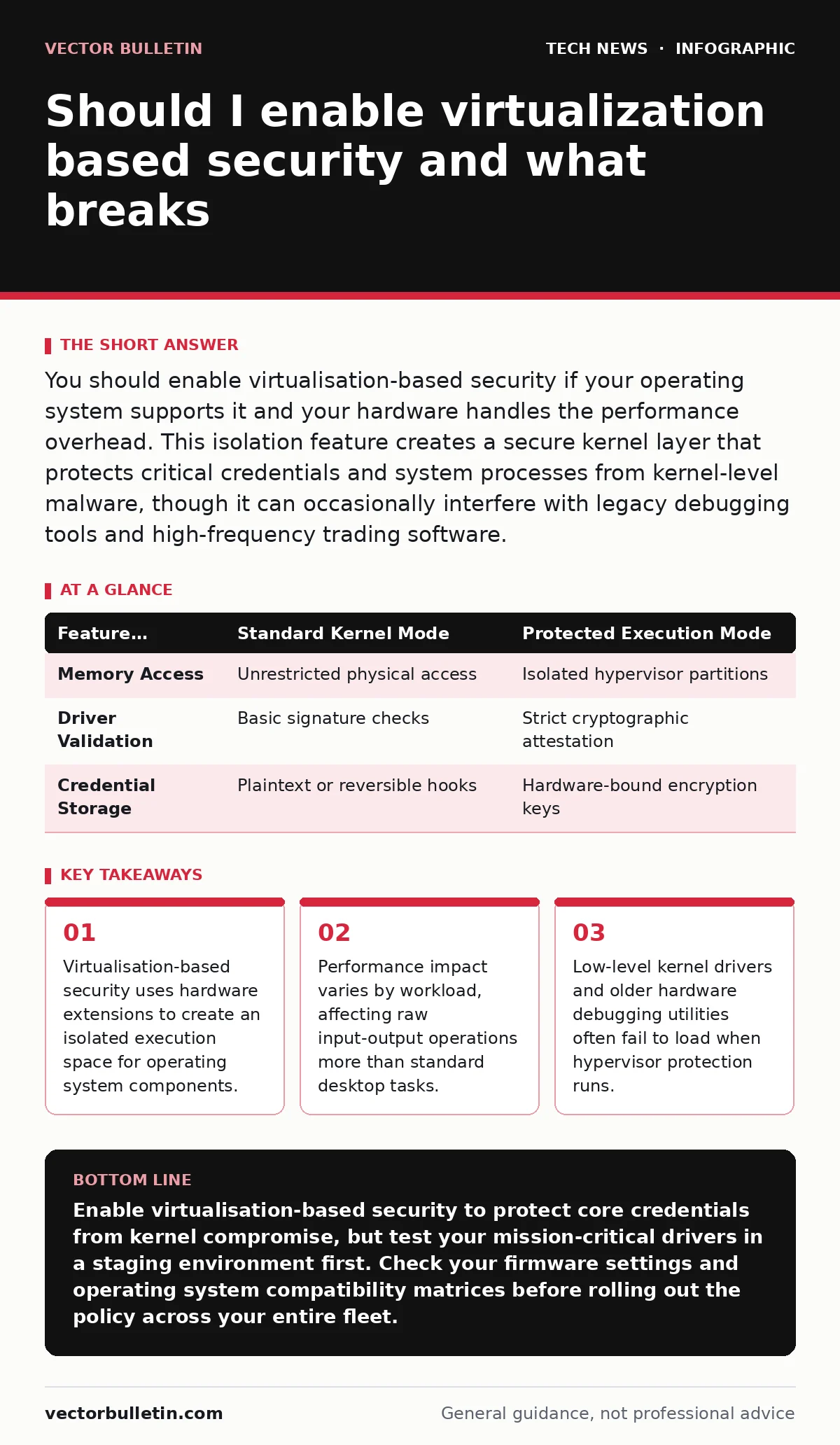
You should enable virtualisation-based security if your operating system supports it and your hardware handles the performance overhead. This isolation feature creates a secure kernel layer that protects critical credentials and system processes from kernel-level malware, though it can occasionally interfere with legacy debugging tools and high-frequency trading software.
Should I enable virtualization based security on production hosts?
You should enable virtualisation-based security on production hosts when hardware capability matches system requirements and performance trade-offs remain acceptable. This setting establishes a hypervisor-protected code integrity layer that prevents unauthorized kernel modifications. Operating system kernels often run with maximum privileges, meaning any compromise grants total machine control. Isolating these components prevents attackers from persisting inside core memory structures even after achieving administrative execution rights.
| Feature Category | Standard Kernel Mode | Protected Execution Mode |
|---|---|---|
| Memory Access | Unrestricted physical access | Isolated hypervisor partitions |
| Driver Validation | Basic signature checks | Strict cryptographic attestation |
| Credential Storage | Plaintext or reversible hooks | Hardware-bound encryption keys |
What mechanisms power hardware-assisted isolation?
Hardware-assisted isolation relies on CPU extensions designed to run a secondary lightweight hypervisor underneath the primary operating system. Modern processors provide nested paging and input-output memory management units that restrict direct hardware access. These extensions allow the system to carve out a secure region of random access memory that the main operating system cannot read directly.
- Nested page tables map virtual memory addresses to physical addresses through dual translation steps.
- Input-output memory management units block direct memory access attacks from compromised peripheral devices.
- Secure boot chains verify every firmware component before the isolation layer initializes.
How does memory virtualization impact system performance?
Memory virtualisation impacts system performance by introducing translation overhead for every page table walk executed by the central processing unit. Every time an application requests data, the hypervisor layer verifies the access rights against the isolated security partition. This additional validation step consumes CPU cycles and increases cache miss rates.
- Raw storage input-output operations experience measurable latency increases under heavy database transactions.
- Virtual machine throughput drops when nested virtualization features stack multiple hypervisor layers.
- Standard desktop applications show negligible slowdowns during normal day-to-day office tasks.
Why do specific third-party kernel drivers fail to load?
Specific third-party kernel drivers fail to load because hypervisor-enforced policies block unsigned or legacy code from modifying core memory. Older software solutions often rely on direct hardware manipulation and undocumented kernel hooks to function. When the isolation layer activates, these direct access methods violate the strict memory integrity rules enforced by the hypervisor.
- Unsigned diagnostic utilities trigger immediate driver blocklists during the boot sequence.
- Legacy backup software attempting low-level disk sector reads encounters permission faults.
- Custom hardware monitoring tools lose direct access to thermal sensors and voltage registers.
What happens to credential storage during credential guard activation?
Credential storage shifts from local software memory to an isolated virtual secure mode container during credential guard activation. Standard operating systems traditionally cache authentication tickets and password hashes in vulnerable memory spaces accessible to compromised administrator accounts. Isolating these secrets ensures that malware cannot extract authentication material even if the primary operating system kernel falls.
- Pass-the-hash attacks fail because local session secrets never reside in standard memory pools.
- Kerberos ticket granting tickets remain encrypted within the protected memory partition.
- Remote desktop security configurations benefit directly from preventing credential theft during active sessions.
Can debugging environments function normally under strict hypervisor policies?
Debugging environments cannot function normally under strict hypervisor policies because low-level kernel debuggers require uninhibited access to memory breakpoints. Kernel debugging fundamentally relies on intercepting CPU instructions and modifying memory pages directly. Hypervisor isolation treats these exact memory modification patterns as malicious tampering attempts and halts the offending process.
- Live kernel debugging sessions terminate instantly upon encountering protected memory regions.
- Diagnostic memory dumps miss internal states held exclusively within the secure virtual partition.
- Developers must use alternative remote debugging channels that communicate through authorized hypervisor APIs.
Key takeaways
- Virtualisation-based security uses hardware extensions to create an isolated execution space for operating system components.
- Performance impact varies by workload, affecting raw input-output operations more than standard desktop tasks.
- Low-level kernel drivers and older hardware debugging utilities often fail to load when hypervisor protection runs.
Enable virtualisation-based security to protect core credentials from kernel compromise, but test your mission-critical drivers in a staging environment first. Check your firmware settings and operating system compatibility matrices before rolling out the policy across your entire fleet.
Frequently asked questions
Does virtualisation-based security prevent all malware infections?
It does not stop application-level malware or phishing attacks, but it successfully blocks persistent kernel-level threats and credential theft.
Can I run nested virtual machines with this feature enabled?
You can run virtual machines inside your host operating system, though performance drops significantly due to triple-nested translation layers.
Will enabling this feature affect my network firewall rules?
Your network firewall rules remain entirely unaffected because the isolation layer operates locally within the host hardware and memory boundaries.
How do I recover if a bad driver prevents system boot?
You must access the physical hardware console or remote management interface to disable the isolation policy through the firmware configuration menu.
How this guide was produced: written by the Vector Bulletin editorial team with AI assistance, checked against the public references listed below, and reviewed when the facts change. See our editorial policy or report an error.