Ransom Notes: Six Misreadings That Cost You Time
Ransom notes are often automated templates or bait files, not unique communications from a specific criminal operator, and treating them as such wastes critical incident response hours.
Do not assume the note is a direct communication from the attacker. It is frequently a static file, a decoy, or a template. Misreading its origin, language, or deadline leads to wasted negotiation efforts. Verify the file’s properties and check for automated indicators before engaging.
Misreading: The note is a unique, hand-crafted message
You might believe the text was written specifically for your organisation. This assumption drives the expectation of personal negotiation. In reality, most ransomware groups use automated scripts to generate these files. The script pulls a generic template and inserts your machine name or a random ID. The content is identical across thousands of infected systems.
Correct reading: Treat the text as a mass-produced artifact. Do not analyse the tone for personality or intent. The lack of personalisation is a feature of the malware’s efficiency, not an oversight. This automation means the "author" is likely a bot, not a human waiting for your reply.
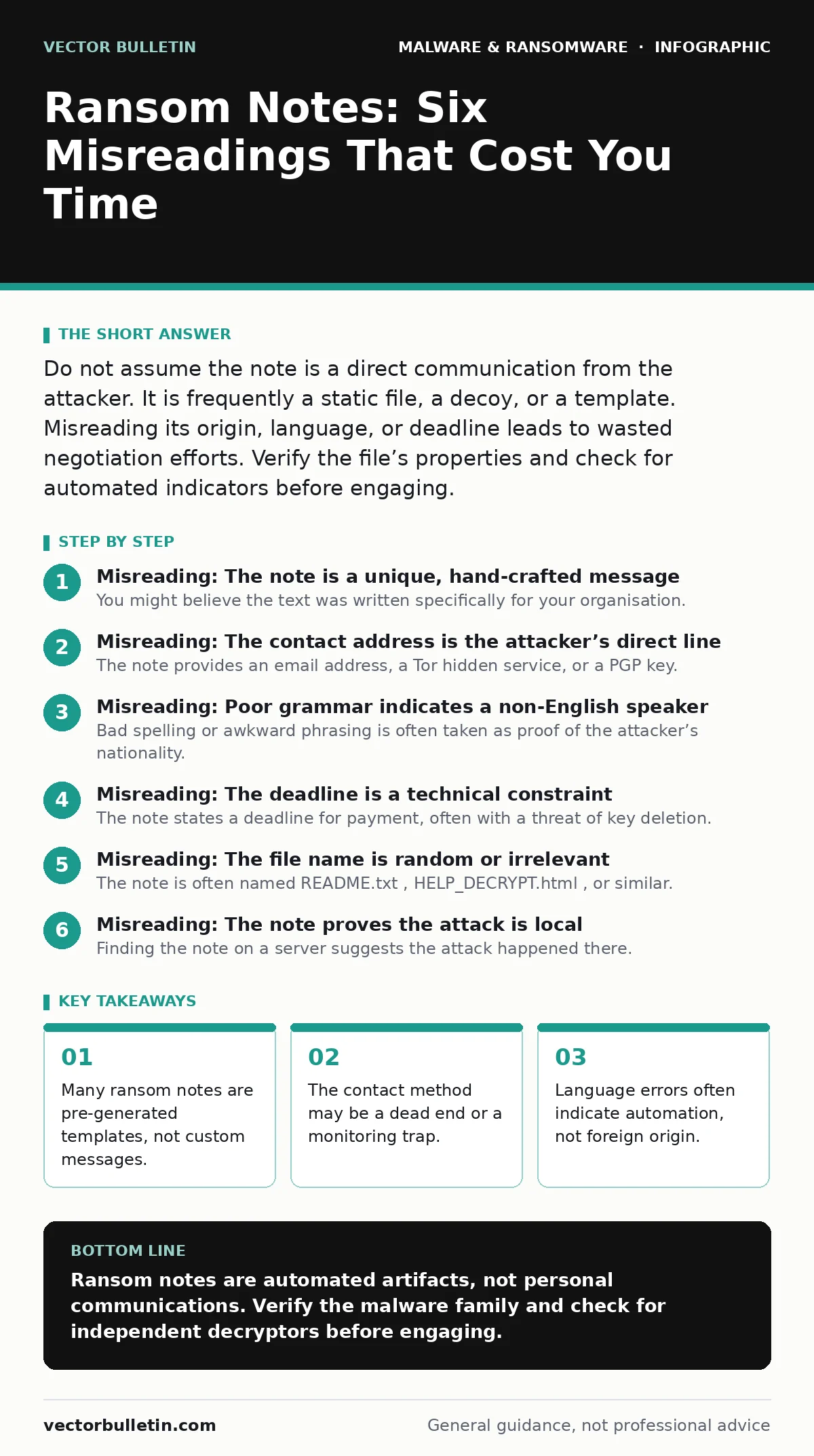
Misreading: The contact address is the attacker’s direct line
The note provides an email address, a Tor hidden service, or a PGP key. You may assume this is the only way to reach the operator. Often, these channels are shared across multiple campaigns or are monitored by security researchers. Sending information here can alert third parties or trigger automated responses that do not involve the attacker.
Correct reading: The contact method is a standardised entry point, not a private channel. It may be a catch-all inbox or a redirect. Using it does not guarantee a response. It also exposes your infrastructure to further probing. Consider the channel as a public bulletin board rather than a direct line.
Misreading: Poor grammar indicates a non-English speaker
Bad spelling or awkward phrasing is often taken as proof of the attacker’s nationality. This leads to assumptions about their location or legal jurisdiction. However, many malware families use translated templates or machine translation. The errors are consistent and repeatable, suggesting a static source file.
Correct reading: Linguistic errors point to automation, not geography. A template written in another language and translated via a free tool will have the same errors on every victim’s system. Do not use language clues for attribution. They are unreliable and distract from technical indicators.
Misreading: The deadline is a technical constraint
The note states a deadline for payment, often with a threat of key deletion. You may fear that missing this window makes decryption impossible. While some older malware variants did delete keys, most modern groups do not. The deadline is a psychological tool to induce panic. It creates urgency that overrides rational decision-making.
Correct reading: The deadline is rarely enforced technically. The encryption keys are usually stored on remote servers long after the stated time. The threat is a negotiation tactic. Verify this by checking if the malware family is known for key deletion. Most are not. Do not let the clock drive your response.
Misreading: The file name is random or irrelevant
The note is often named README.txt, HELP_DECRYPT.html, or similar. You might ignore the filename as generic. In many cases, the filename is a signature of the malware family. Specific names are used by specific groups and rarely change. This allows for immediate identification without deep analysis.
Correct reading: The filename is a valuable indicator of compromise. It often matches known malware families in threat intelligence databases. Checking the name against public records can identify the variant quickly. This saves time compared to analysing the file’s content. Always preserve the original filename during collection.
See also: Lateral Movement Response: Containment, Recovery and Prevention Steps
Misreading: The note proves the attack is local
Finding the note on a server suggests the attack happened there. You may focus your investigation on that single host. However, ransomware often spreads laterally before encrypting. The note appears on the most visible or critical system last. The initial entry point may be elsewhere in the network.
Correct reading: The note marks the end of the encryption phase, not the start of the attack. The malware likely moved through the network before reaching this host. Investigate network logs and other endpoints. The presence of the note confirms the breach is active, but not where it began. Look for lateral movement indicators.
Misreading: The decryption promise is absolute
The note claims a decryptor exists or will be provided. You may trust this claim and wait for instructions. Some malware families do not have a working decryptor. Others may provide a partial tool that only works on specific files. The claim is marketing, not a guarantee.
Correct reading: Verify the existence of a decryptor independently. Use public resources to check if the malware family has a known decryption tool. Do not rely on the note’s assertions. If no tool exists, the note is a dead end. Focus on restoration from backups instead.
Misreading: The note is the only evidence
You may focus exclusively on the ransom note for clues. This ignores other artifacts left by the malware. The note is one component of a larger payload. Other files, registry changes, or network connections provide more reliable data. Relying solely on the note gives a partial view.
Correct reading: Treat the note as one piece of evidence. Collect memory dumps, network logs, and file system artifacts. Analyse these alongside the note. This provides a complete picture of the infection. The note confirms the outcome, but other data reveals the method.
Misreading: The attacker is waiting for a reply
You may assume the operator is monitoring the channel for your response. This leads to prolonged waiting periods. In many cases, the group uses a drop-box system. You upload payment details, and a script processes them. No human reads your message immediately.
Correct reading: The interaction is likely automated. Expect delays and generic responses. Do not interpret silence as rejection. It may simply be queue processing. Adjust your expectations for communication speed. This reduces frustration during the response phase.
Misreading: The note contains unique encryption details
You might look for the public key in the note itself. Some notes include it, but many do not. The key is often embedded in the encrypted files or stored remotely. Searching the note for cryptographic material can be futile.
Correct reading: Check the encrypted files for embedded keys. Some malware variants store the public key in the header of each encrypted file. This allows for offline analysis. Do not assume the note holds all technical details. The payload itself is often more informative.
Misreading: The note is safe to read on the infected system
You may open the note on the compromised machine to read it. This can trigger additional malicious code. Some notes are HTML files with embedded JavaScript. Others use links that connect to command and control servers. Reading the note can expand the attack.
Correct reading: Copy the note to an isolated, clean system for analysis. Do not open it on the infected host. Use a sandbox or air-gapped machine. This prevents further execution or network calls. Treat the note as potentially active malware, not just text.
Misreading: The note’s language defines the threat level
A note in your local language may seem more threatening. You might assume a local attacker is more dangerous. Conversely, a foreign language note may seem less urgent. This bias affects response prioritisation. The threat level is defined by the malware’s capabilities, not its language.
Correct reading: Assess the threat based on technical indicators. The encryption strength, lateral movement, and data exfiltration matter. Language is irrelevant to the risk. Prioritise response based on the impact, not the tone. This ensures consistent handling of all incidents.
Misreading: The note is the final stage
You may believe the attack ends with the note. This leads to premature containment. The malware may still be active, spreading or exfiltrating data. The note is a signal, not a stop condition. The attackers may still have access.
Correct reading: Assume the network is still compromised. Isolate affected systems immediately. Hunt for residual processes and connections. Do not assume the threat is contained. The note is a milestone, not the end. Continue investigation until the breach is fully closed.
Key takeaways
- Many ransom notes are pre-generated templates, not custom messages.
- The contact method may be a dead end or a monitoring trap.
- Language errors often indicate automation, not foreign origin.
- Deadlines are psychological pressure, not technical constraints.
Ransom notes are automated artifacts, not personal communications. Verify the malware family and check for independent decryptors before engaging.
Frequently asked questions
Should I pay the ransom if the note promises a decryptor?
No. Payment does not guarantee decryption or silence. It funds further attacks and may not result in key delivery. Focus on backups and restoration.
Can ransom notes contain additional malware?
Yes. Some notes are executable files or HTML with scripts. They can install secondary payloads. Always analyse in a sandboxed environment.
How do I identify the malware family from the note?
Check the filename, text structure, and contact methods. Compare these with public threat intelligence. Many families have distinct signatures.
Is the contact address in the note safe to use?
Not necessarily. It may be monitored or shared. Use it cautiously and assume it is not a private channel. Consider legal and ethical implications.
How this guide was produced: written by the Vector Bulletin editorial team with AI assistance, checked against the public references listed below, and reviewed when the facts change. See our editorial policy or report an error.