
What is e-commerce security and how to protect digital shops
Online store protection relies less on locking the front door and more on verifying every single transaction passing through the back.
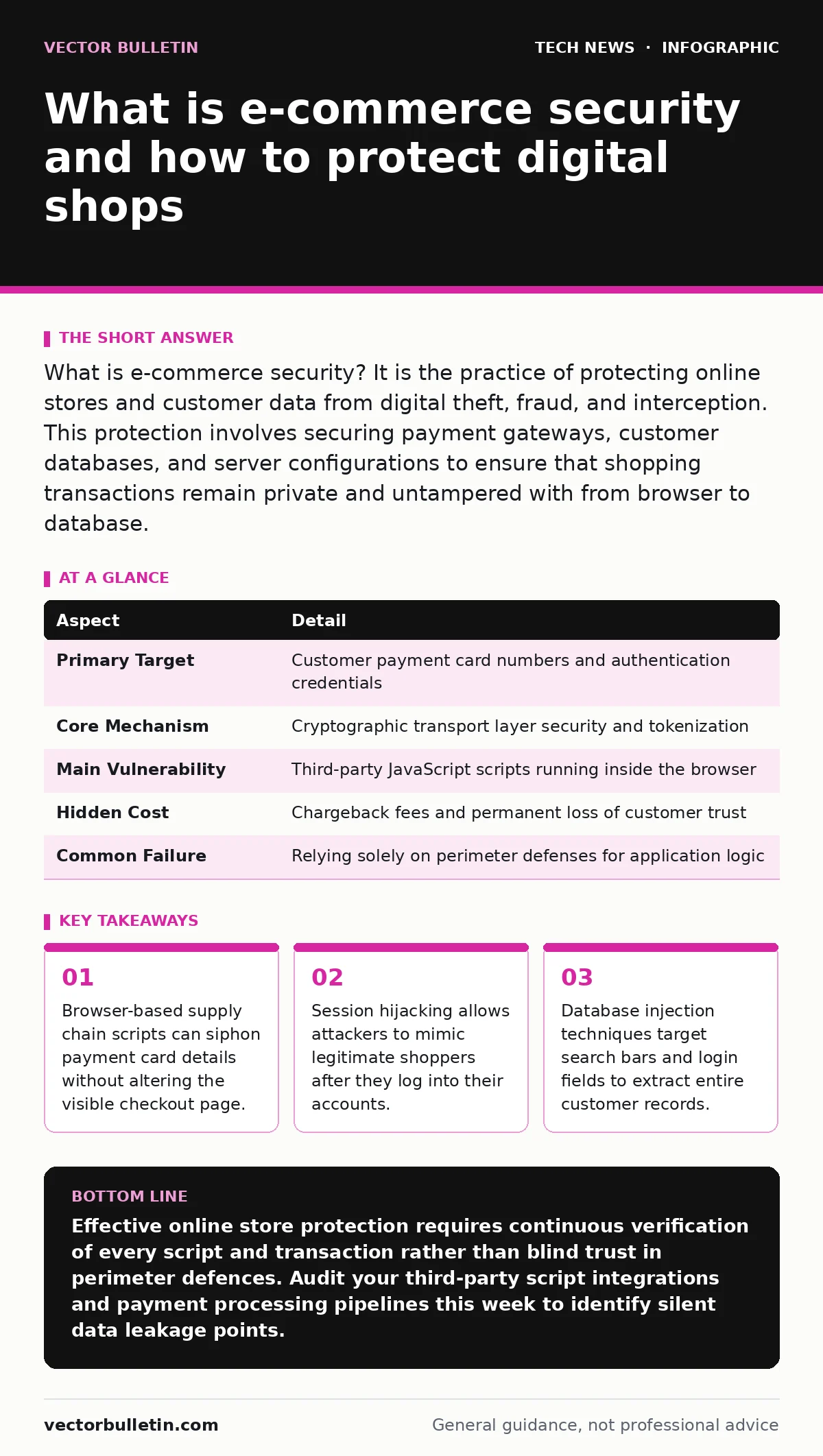
What is e-commerce security? It is the practice of protecting online stores and customer data from digital theft, fraud, and interception. This protection involves securing payment gateways, customer databases, and server configurations to ensure that shopping transactions remain private and untampered with from browser to database.
What is e-commerce security in physical retail terms
Imagine running a high street shop where customers drop coins through a slot in the wall while invisible clerks handle the merchandise behind a mirrored glass. E-commerce security functions in much the same way, creating digital trust between anonymous buyers and automated servers across vast network distances. Every digital storefront must authenticate users, encrypt transit data, and validate incoming requests before fulfilling orders.
Digital merchants face distinct operational challenges because their shops remain open continuously to global visitors. Traditional physical security relies on locks and guards, whereas electronic commerce relies on cryptographic protocols, strict access controls, and continuous behavior monitoring. Without these measures, a digital shop becomes vulnerable to automated abuse and silent data extraction.
| Aspect | Detail |
|---|---|
| Primary Target | Customer payment card numbers and authentication credentials |
| Core Mechanism | Cryptographic transport layer security and tokenization |
| Main Vulnerability | Third-party JavaScript scripts running inside the browser |
| Hidden Cost | Chargeback fees and permanent loss of customer trust |
| Common Failure | Relying solely on perimeter defenses for application logic |
How payment tokenisation changes the transaction risk
Payment tokenisation replaces sensitive credit card numbers with random strings of characters before storing or processing the data. This mechanism ensures that even if an attacker breaches the primary customer database, they find only useless tokens rather than raw financial credentials. The original card data stays safely inside a dedicated vault managed by specialized financial institutions.
This approach drastically reduces the scope of regulatory compliance audits for online merchants. However, tokenisation introduces reliance on external services, meaning any disruption in the token vault provider halts checkout capabilities instantly. Merchants must design fallback procedures that maintain user experience without compromising transaction safety.
Who is affected by digital storefront vulnerabilities
Online shoppers bear the immediate brunt of credential theft and fraudulent purchases draining their personal bank accounts. Merchants suffer financial losses through stolen inventory, chargeback penalties, and the expensive forensic investigations required after a security incident. Payment processors and financial institutions also absorb significant fraud losses when compromised cards flood the banking network.
Third-party suppliers connected to the online store experience collateral damage when their compromised software components serve as the initial vector for an attack. Software developers face reputational damage if their code introduces flaws into the checkout pipeline. Even hosting providers share the burden when malicious traffic targets their infrastructure through vulnerable store applications.
What to do about browser-based supply chain attacks
Modern online stores load dozens of external scripts for analytics, marketing, and customer support directly into the shopper's browser. Attackers routinely compromise these third-party vendors to inject malicious code that records keystrokes on the payment page. Content Security Policy headers restrict which domains can load scripts and where those scripts can send collected data.
Subresource Integrity checks ensure that browsers load external JavaScript files only if their cryptographic hash matches the expected value. If a vendor modifies their script maliciously, the browser blocks execution immediately. Implementing these controls requires meticulous maintenance because marketing teams frequently add new tracking tools that break strict security rules.
What people usually get wrong about online retail safety
Many merchants believe that using an off-the-shelf shopping platform eliminates the need for internal security oversight. Platforms handle core infrastructure updates, but store administrators still configure access permissions, install third-party plugins, and manage API key security carelessly. Another common misconception treats security as a one-time setup task rather than an ongoing operational discipline.
Store owners often rely entirely on perimeter firewalls while ignoring application-layer logic flaws that allow attackers to manipulate pricing parameters. If you neglect internal data flows, attackers can exploit business logic errors to purchase expensive goods for nominal amounts. True resilience requires examining every interaction between the user interface and the underlying database.
Key takeaways
- Browser-based supply chain scripts can siphon payment card details without altering the visible checkout page.
- Session hijacking allows attackers to mimic legitimate shoppers after they log into their accounts.
- Database injection techniques target search bars and login fields to extract entire customer records.
Effective online store protection requires continuous verification of every script and transaction rather than blind trust in perimeter defences. Audit your third-party script integrations and payment processing pipelines this week to identify silent data leakage points.
Frequently asked questions
Can a small online shop be targeted by automated cyber attacks?
Automated bots scan the internet continuously for vulnerable shopping platforms, meaning even low-traffic stores face constant credential stuffing and vulnerability probing.
Why do payment gateways require redirecting customers to external pages?
Redirecting customers isolates the most sensitive credit card input fields away from the main merchant server, minimizing the merchant's regulatory burden and liability.
How do malicious actors hide their activities inside an online store?
Attackers often inject malicious code deep within legitimate plugin directories or disguise their traffic as normal customer browsing sessions to evade detection.
What happens to a store's search engine ranking after a security breach?
Search engines often flag compromised websites with warning labels to protect users, causing an immediate drop in organic visitor traffic and revenue.
How this guide was produced: written by the Vector Bulletin editorial team with AI assistance, checked against the public references listed below, and reviewed when the facts change. See our editorial policy or report an error.