
Opting Out of Data Brokers: The Mechanics and Limits of Removal
Opting out triggers a manual review process that often fails to stop re-aggregation from public records and passive collection channels.
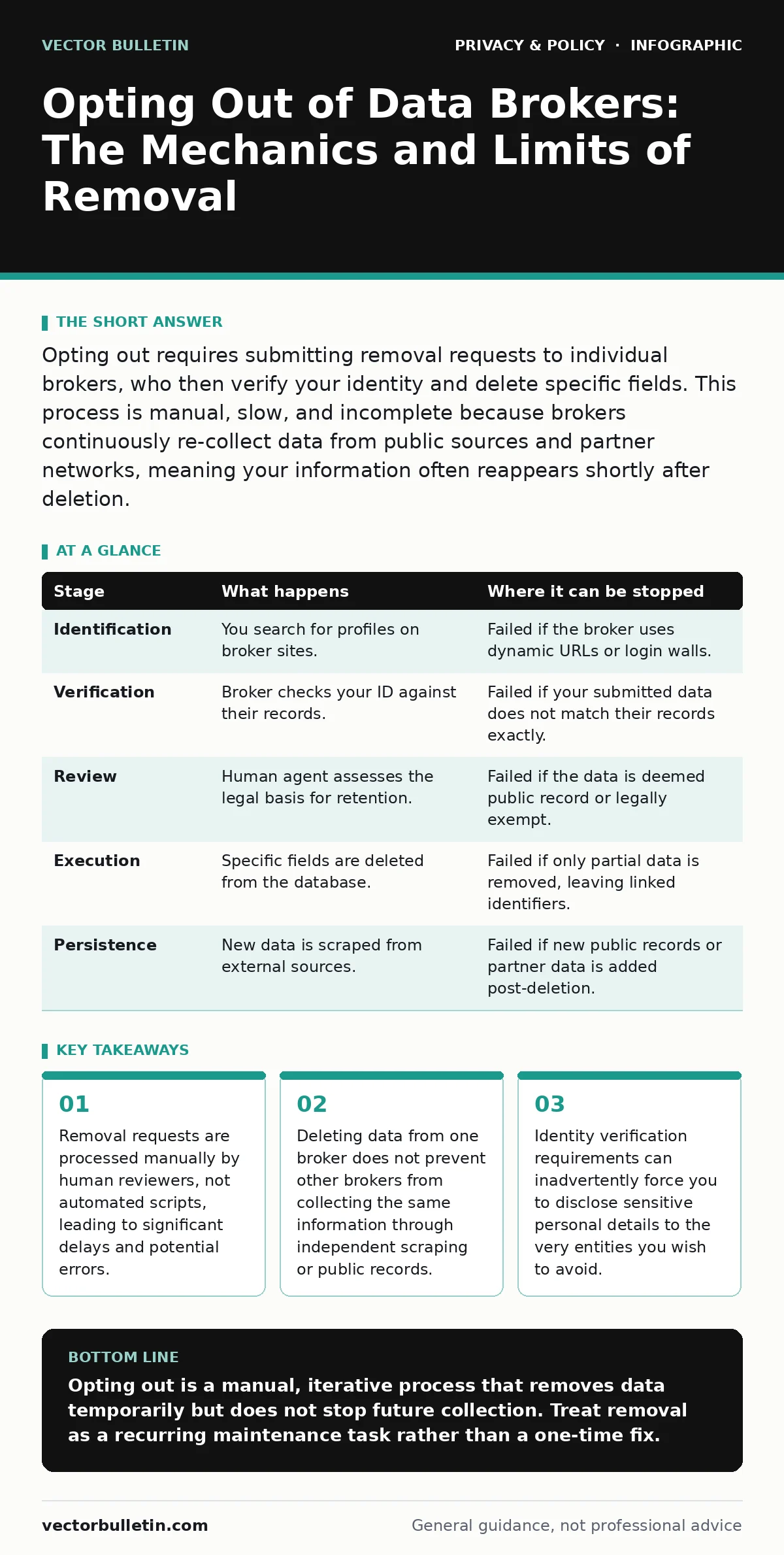
Opting out requires submitting removal requests to individual brokers, who then verify your identity and delete specific fields. This process is manual, slow, and incomplete because brokers continuously re-collect data from public sources and partner networks, meaning your information often reappears shortly after deletion.
The Illusion of Automated Deletion
You might assume that opting out of data brokers is a technical switch you flip. It is not. The process relies on human labour and inconsistent internal policies. When you submit a request, you are not sending a command to a database. You are sending a letter to a compliance team.
This distinction matters because automation implies consistency. Human review implies variance. One broker might interpret "remove all data" as deleting your name and address. Another might keep your phone number because it was sourced from a directory listing rather than a direct purchase.
The mechanism begins with discovery. You must identify which entities hold your information. There is no central registry of data brokers. You must cross-reference known lists, search for your own details on search engines, and visit individual opt-out pages. This initial phase is the most labour-intensive part of the process.
Stage 1: Identification and Verification
Stage 1: Locating Your Profile
Before you can remove data, you must find it. Brokers do not publish searchable directories of their holdings for privacy reasons. You must search for yourself using unique identifiers like your full name combined with your location or previous addresses.
Imagine you find a profile that lists your current address and phone number. You click the "Opt-Out" or "Delete" link. This link leads to a form. The form asks for your name, address, and sometimes a government ID number. This is the first trade-off. To prove you are the person in the database, you must provide data that confirms your identity.
Stage 1: The Verification Loop
The broker receives your request. They do not automatically delete the data. They verify that the person requesting deletion is the person in the database. This prevents malicious actors from deleting other people’s data.
This verification step is where many requests fail. If the address you provide does not match the address on file exactly, the request is rejected. You must then resubmit with corrected information. This loop can repeat several times. Each submission adds a new timestamp and potentially new metadata to your record.
Stage 2: The Manual Review Process
Stage 2: Human Intervention
Once verified, your request enters a queue. It is reviewed by a human agent. This agent checks the source of the data. If the data came from a public court record, they may refuse to delete it, citing legal exemptions. If it came from a survey you filled out years ago, they may delete it.
This stage highlights a hidden cost: time. The review process can take weeks or months. During this period, your data remains active and searchable. It is still being sold or shared with partners. The "opt-out" status is not immediate. It is pending.
Consider the difference between active and passive data. Active data is information you provided directly, like a survey response. Passive data is information inferred or scraped, like your membership in a club found on a public website. Brokers are more likely to retain passive data because they did not "create" it; they merely indexed it.
Stage 3: Execution and Partial Deletion
Stage 3: What Actually Gets Removed
When the agent approves the deletion, they execute the removal. This is rarely a blanket wipe. The agent deletes specific fields. Your name might be removed, but your phone number might remain if it is linked to a different household member. Or your address might be kept if it is considered "public record."
This partial deletion creates a fragmented profile. You might be removed from the "contacts" table but remain in the "demographics" table. The broker still knows who you are, but they cannot easily link your name to your preferences. This is a form of pseudonymisation, not true erasure.
Stage 4: Re-aggregation and Persistence
Stage 4: The Cycle of Re-collection
The final stage is the one most people miss. Deletion is not permanent. Brokers continuously scrape new data. If your information appears in a new public record, a social media post, or a partner’s database, it gets added back.
This happens because the opt-out request only applies to the data held at the time of the request. It does not create a standing order to ignore you in the future. You must repeat the process periodically. This is the "hydra" effect of data brokerage. Cut off one head, and two more grow from new sources.
The limit of opting out is therefore temporal. It works for a snapshot in time. It does not work as a long-term privacy shield. You are fighting a continuous flow of information with a discrete, manual action.
Limits and Edge Cases
The process fails in specific scenarios. If your data is held by a broker that does not comply with opt-out laws, your request is ignored. There is no enforcement mechanism for individual requests. You must rely on the broker’s self-policing.
Another limit is the "derived data" problem. If a broker inferred your income level from your zip code and car model, deleting your name does not delete the inference. The statistical profile remains. The broker still knows the characteristics of the person who lives at that address.
Synthesis of the Process
The following table summarises the stages, the actions taken, and the points where the process can stall or fail.
| Stage | What happens | Where it can be stopped |
|---|---|---|
| Identification | You search for profiles on broker sites. | Failed if the broker uses dynamic URLs or login walls. |
| Verification | Broker checks your ID against their records. | Failed if your submitted data does not match their records exactly. |
| Review | Human agent assesses the legal basis for retention. | Failed if the data is deemed public record or legally exempt. |
| Execution | Specific fields are deleted from the database. | Failed if only partial data is removed, leaving linked identifiers. |
| Persistence | New data is scraped from external sources. | Failed if new public records or partner data is added post-deletion. |
Strategic Implications
Understanding these stages changes how you approach privacy. You cannot "solve" data brokerage with a one-time opt-out. You must treat it as a maintenance task. This aligns with the principles of privacy by design, where you minimise the data you expose in the first place.
If you reduce the amount of personal data available online, there is less for brokers to scrape. This includes being cautious about file metadata in documents you share publicly and managing children's online privacy risks by restricting their digital footprint early.
The effort required to opt out is high. The benefit is temporary. The most effective strategy is not just removal, but prevention. Limit the data you share with services that might sell it. Use email aliases to create a barrier between your primary identity and online interactions.
Conclusion of Mechanics
The mechanism of opting out is a negotiation, not a command. You ask, the broker verifies, and then they decide what to keep. The limits are defined by law, technology, and the broker’s business model. You gain a temporary reduction in visibility, but you do not gain invisibility.
The next step is not just to opt out, but to monitor. Set up alerts for your name and contact details. When they reappear, you know the cycle has restarted. This ongoing vigilance is the true cost of privacy in the data economy.
Key takeaways
- Removal requests are processed manually by human reviewers, not automated scripts, leading to significant delays and potential errors.
- Deleting data from one broker does not prevent other brokers from collecting the same information through independent scraping or public records.
- Identity verification requirements can inadvertently force you to disclose sensitive personal details to the very entities you wish to avoid.
Opting out is a manual, iterative process that removes data temporarily but does not stop future collection. Treat removal as a recurring maintenance task rather than a one-time fix.
Frequently asked questions
Can I opt out of all data brokers at once?
No, there is no central registry or single switch to remove your data from all brokers. You must submit requests to each entity individually.
How long does it take for data to be deleted?
Deletion times vary by broker, ranging from a few days to several months. The manual review process causes significant delays.
Will my data come back after I opt out?
Yes, brokers continuously re-collect data from public sources and partners. Your information can reappear if new data points are added to the public record.
Is it legal for brokers to keep some of my data?
Yes, brokers may retain data derived from public records or data that is legally exempt from deletion under certain privacy laws.
How this guide was produced: written by the Vector Bulletin editorial team with AI assistance, checked against the public references listed below, and reviewed when the facts change. See our editorial policy or report an error.